
Livestock and Fertiliser Odour Monitoring Saudi Arabia
Saudi Odour Monitoring provides livestock and fertiliser odour monitoring in Saudi Arabia for livestock, agriculture, composting and fertiliser operators, building a practical investigation around sources, ammonia or other relevant measurements, patrol observations, wind and event records. Agricultural odour changes with animals, feed, housing, manure handling, storage, land application, fertiliser transfer and weather, so a short observation at the gate cannot represent every operating condition.
You receive a written proposal setting out the investigation plan, equipment, scope, lead time and price. Request a quotation
The objective is to identify patterns and test operational improvements. Monitoring is not a generic emissions inventory and does not itself remove odour.
Build a source and activity register
For livestock operations, potential sources include housing, ventilation outlets, yards, bedding, manure collection, lagoons or tanks, solids handling, composting, loading and land application. Feed storage and carcass or mortality-management areas may require separate consideration where present. A fertiliser operation can involve receiving, storage, blending, bagging, transfer, loading, dust collection, process exhausts and wastewater. Each source should be tied to an activity, timing and possible release route.
Ammonia is often relevant, but it is not synonymous with total odour. The CDC/NIOSH Pocket Guide describes ammonia as a colourless gas with a pungent, suffocating odour and documents its health hazards. Measurement plans must distinguish environmental odour investigation from workplace exposure and emergency detection. Personal safety controls, respiratory-protection decisions and process safety remain with the operator’s health-and-safety team.
For projects focused on ammonia and sulfur signals, see hydrogen sulfide, ammonia and reduced-sulfur monitoring. The parameter list should still follow the actual sources and expected ranges.
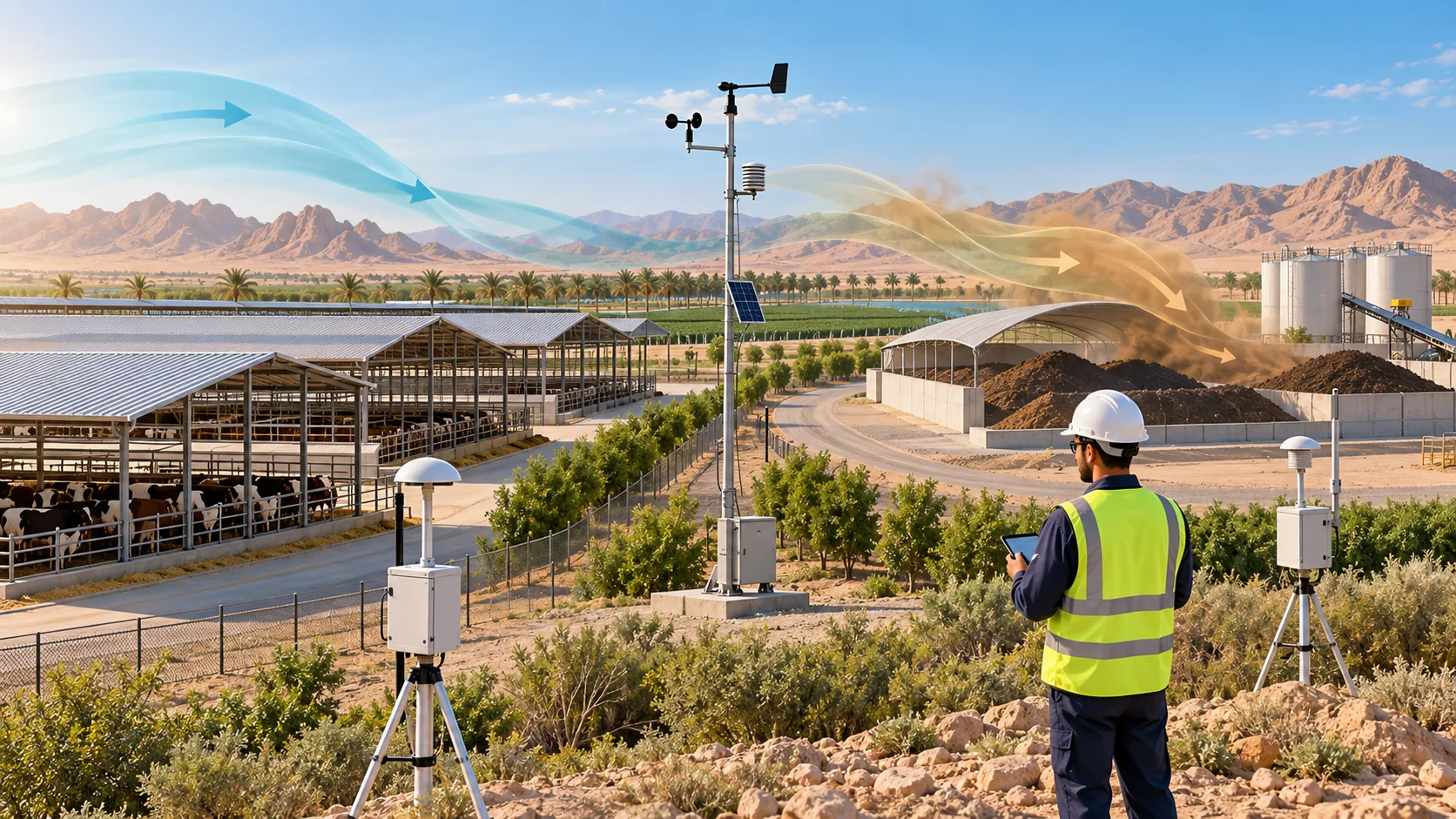
Livestock and fertiliser odour monitoring: weather and operational events
Portable surveys can compare defined routes and safe accessible points. Temporary or fixed monitors can capture repeatable patterns near priority sources, boundaries or receptors. Wind direction and speed are essential for testing whether a reported event is consistent with a source area. Temperature and humidity may also help explain changes in sensor response or process conditions.
Operating logs should include animal occupancy where relevant, ventilation state, manure movement, lagoon or tank work, compost turning, fertiliser transfer, loading, cleaning, maintenance, process interruptions and land-application timing. Complaint records should capture time, location, duration and character neutrally. The combined review identifies which events merit closer inspection or sampling, without converting coincidence into proven attribution.
Meteorology, dispersion and source-attribution support can organise the evidence when several sources or changing winds are involved. Formal regulatory modelling is a separate study scope delivered through a qualified modelling partner.
Decide when sensory or analytical evidence is needed
An ammonia sensor provides compound-specific information within its verified range, while a broad VOC sensor responds to a different subset of chemicals. Human observations can describe odour intensity and character but need a controlled field protocol and trained delivery. Laboratory analysis may be appropriate when source samples, odour concentration or compound identity is required.
Sampling from a housing exhaust, manure store, lagoon surface, compost pile or process outlet requires source-appropriate equipment and a chain-of-custody plan. Odour source sampling strategy defines that workstream. Dynamic olfactometry and analytical results come from the named laboratory.
Operational improvement and Saudi delivery
Monitoring can compare changes in manure removal, cover condition, storage practice, ventilation, compost turning, transfer procedures or treatment equipment when conditions are documented. A useful test defines the operating state, before/after period, weather window and success indicator, and accounts for process variability and sample uncertainty.
This livestock, agriculture and fertiliser odour service is available for projects across Saudi Arabia, including Riyadh, Al Qassim, Jeddah and the Eastern Province.
Saudi heat, intense sun, dust and long distances between agricultural locations affect enclosure selection, mounting, power and maintenance. Coastal humidity may matter at western or eastern sites. Remote connectivity should be tested rather than assumed.
Deliverables can include:
- a source/receptor map and activity log;
- a survey route, parameters and ranges, and monitoring schedule;
- weather requirements and sampling decision points;
- a QA/maintenance plan and alarm or action matrix;
- a findings report.
To begin, provide the site plan, livestock or process details, source activities, complaint history, existing measurements, seasonal/operating schedule, controls, safety rules, power/connectivity and required decision.
Seasonal and daily representation is stated in the report. Animal occupancy, feed, manure condition, fertiliser demand, land application and ventilation can change. A campaign that covers only one activity window is not generalised to the full year; the report identifies which additional operating or weather condition needs confirmation.
Frequently asked questions
Who provides livestock and fertiliser odour monitoring in Saudi Arabia?
Saudi Odour Monitoring provides livestock and fertiliser odour monitoring planning, equipment and event-evidence review for agricultural operators across Saudi Arabia. Laboratory work is coordinated through the named laboratory.
Is ammonia a complete measure of agricultural odour?
No. Ammonia can be an important measurable component, but total odour may involve multiple compounds and sensory characteristics. The investigation should not use one ammonia reading as a universal odour value.
How do I choose which livestock and fertiliser sources to monitor?
Relevant sources may include housing ventilation, yards, bedding, manure collection and storage, lagoons, solids handling, composting, loading and land application. Actual operations and complaint timing determine priorities.
Can a monitoring service evaluate a change in manure management?
Yes, when the before/after operating states, weather, source activity and measurement conditions are documented. Repeated comparable observations are more useful than one isolated reading.
When is laboratory or sensory testing required?
Use sensory or analytical work when the decision requires odour concentration, character under a defined method, or compound identity beyond field sensors. The laboratory and method are named in the scope.
What affects the cost of livestock and fertiliser odour monitoring?
Cost depends on the number of sources and monitoring points, the sensors and parameters, power and connectivity, the monitoring duration and any sampling or laboratory work. Configuration and lead time are confirmed in each quotation.
How long does agricultural odour monitoring take?
Timing depends on the seasonal and operating cycles to be observed, equipment configuration and any sampling. Lead time is confirmed in your quotation.
Saudi Odour Monitoring serves projects across Saudi Arabia, including Dammam, Al Khobar, Jubail, Riyadh, Jeddah, NEOM and Qiddiya.
For livestock and fertiliser odour monitoring in Saudi Arabia, share your site plan and operating schedule and request a quotation.