
Landfill and Compost Odour: Sources, Weather and Monitoring Strategy
This guide explains how to monitor landfill odour in Saudi Arabia, along with compost and waste-facility odour, because odour at a waste facility changes with the material, operation, control condition and weather. A landfill working face, leachate system, gas collection component and waste transfer area can create different signatures. At a composting site, receiving, active decomposition, turning, curing and storage may each matter at different times. One boundary reading cannot explain this changing source map by itself.
A practical strategy connects three evidence layers: what was happening at the source, what was measured along the pathway, and what was observed at the receptor. This helps Saudi landfill, compost, transfer and organics-processing teams move from general complaints to testable operational questions. You receive a written proposal setting out the configuration, scope, lead time and price. Request a quotation
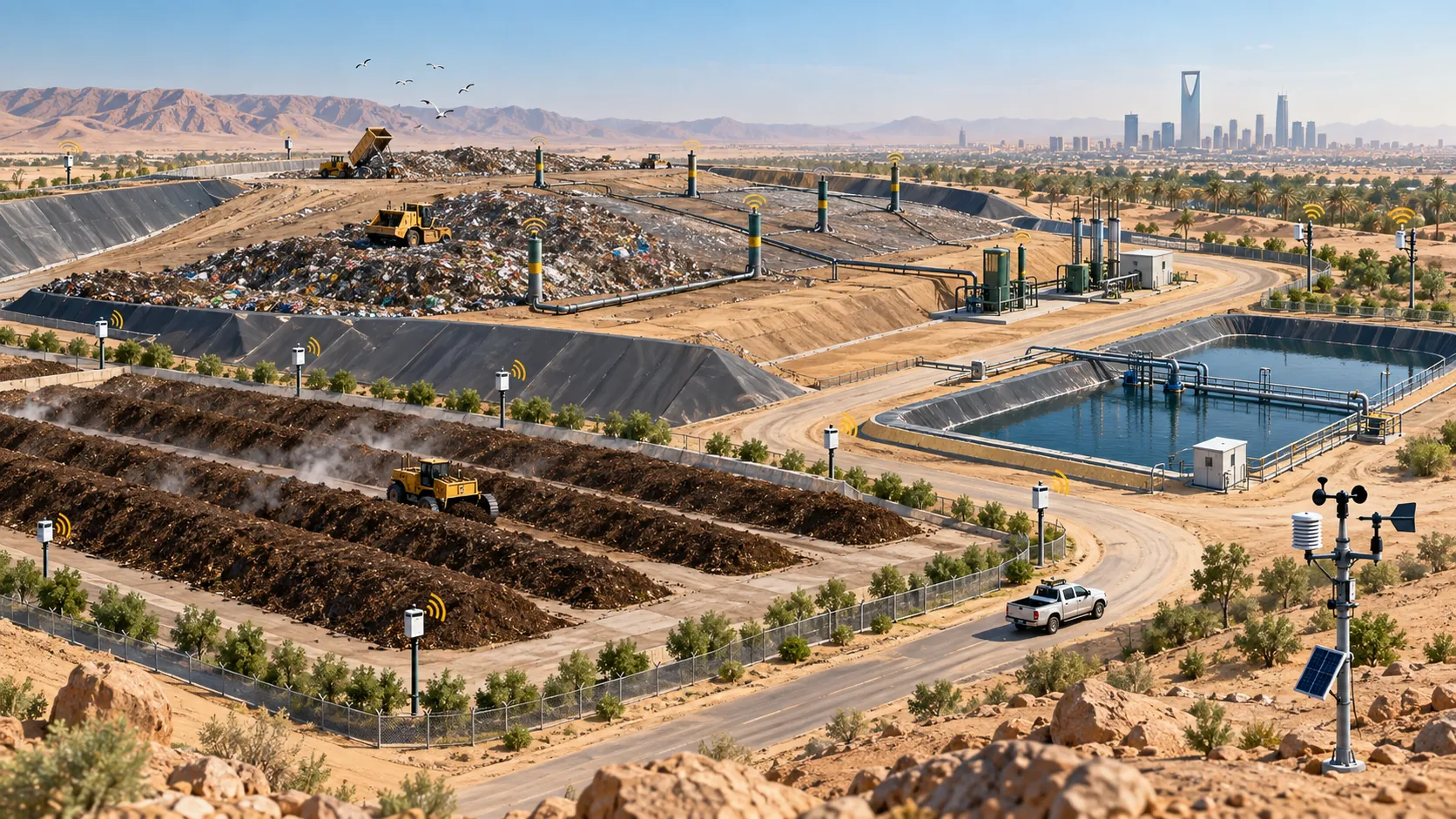
Build a live source inventory
Start with locations and activities, not a generic pollutant list. For a landfill, map the active face, daily cover, intermediate or capped areas, landfill-gas wells and headers, leachate ponds or tanks, transfer stations and vehicle queues. For composting, map feedstock receipt, mixing, active piles or vessels, turning, aeration, curing, screening, reject storage and runoff management.
Add operating states. Note waste type, exposed area, cover work, gas-system downtime, leachate movement, windrow age, turning, moisture adjustment, equipment failure and maintenance. The inventory should be easy for operators to update; a perfect drawing that is never revised is less useful than a controlled daily log.
The landfill, compost and waste-facility odour monitoring solution is the route for a configured project. This article explains the monitoring logic and does not provide a landfill permit, siting opinion, closure plan or waste licence.
How to monitor landfill odour: methods for Saudi Arabia
At source level, targeted gas or VOC measurements can screen process areas and identify changing patterns. Surface or component surveys may be appropriate for specific questions, while source sampling and dynamic olfactometry require suitable equipment and a qualified laboratory. Broad electronic odour or VOC indicators can provide time trends, but they do not automatically identify compounds or reproduce human sensory response.
Boundary monitoring asks whether an odour-related signal appears at selected perimeter locations. Locations should reflect prevailing and variable winds, site geometry, access, power and relevant receptors. A single “downwind” point will not remain downwind under every condition. Portable surveys or planned odour patrols can investigate gaps between fixed stations.
At receptor level, complaint records and structured field observations provide information that an onsite sensor may miss. Record time, place, duration, character and intensity using a consistent process. Do not assume the facility is the source until the timing, wind, operations and alternative sources have been checked.
Use weather as context, not a verdict
Wind direction and speed help identify which source areas were upwind during an event. Calm or variable conditions can complicate that comparison, and local terrain, stockpiles and buildings can alter airflow. Temperature, humidity, rainfall and atmospheric stability may also affect generation, release, transport or perception.
Align weather, monitoring and operating records to the same clock and interval. Review conditions before, during and after a complaint rather than selecting one convenient wind arrow. Repeated co-occurrence can strengthen a hypothesis and guide further sampling; it does not, by itself, establish formal source attribution.
For recurring community events, the odour complaint investigation and response planning solution provides the operational workflow. Formal dispersion modelling or regulatory conclusions need an appropriate scope and delivery partner.
Design the programme around actions
Define what happens when a threshold, complaint or pattern is detected. The first response might be to check instrument health, confirm wind, inspect cover, review a turning event, verify gas extraction, inspect leachate handling or pause a non-critical activity under an approved operating procedure. Assign owners and record findings, photographs and corrective actions.
Separate measurement alerts from instrument faults and communication loss. Thresholds should have a documented basis; an internal operational level is not automatically a regulatory limit. Trend reports should show data availability, maintenance, exclusions and source activity as well as measured values.
A staged approach usually works best: initial screening and source mapping, a focused temporary deployment, then permanent points where the evidence shows continuing value. Include cleaning, calibration or verification, consumables, solar and battery performance where used, communications, access and spare parts in the lifecycle plan.
Review whether controls changed the outcome
Monitoring should support comparison, not merely collection. Define a baseline period and compare similar operating and weather conditions before and after a change. If cover practice, aeration, gas capture or leachate management changes, record the date and expected pathway. One quiet day is not proof of long-term control performance.
The odour-control performance monitoring solution covers measurement and verified response workflows. Engineering design, control logic and safety remain with the responsible process and controls professionals.
Frequently asked questions
What are common landfill odour areas to include in a source map?
Consider the working face, cover condition, gas collection assets, leachate handling, transfer or unloading, exposed waste, vehicle queues and temporary operational areas. Site knowledge should determine the final list.
How do I monitor landfill odour and choose boundary monitoring locations?
One monitor usually cannot cover an entire waste facility under all wind directions and source states. The required number and locations depend on the objective, site geometry, receptors, weather and available access. Temporary monitoring can test the design.
Does a complaint prove the facility caused an odour?
No. A complaint is important evidence of time, place and perception, but attribution requires comparison with wind, operations, measurements and other possible sources.
When is dynamic olfactometry useful?
It is useful when a decision requires odour concentration from a source sample under a recognised method. Sampling and analysis should be planned with a qualified odour laboratory before field collection.
Who provides landfill odour monitoring in Saudi Arabia?
Saudi Odour Monitoring supplies configured odour monitoring for landfill, compost, transfer and organics-processing sites across Saudi Arabia.
What affects the cost of landfill odour monitoring?
The number of source areas and boundary points, measured parameters, communications and power, the length of any temporary deployment, and accessories. The price is set out in your quotation.
How long does it take to set up landfill odour monitoring?
It depends on the site mapping, locations, access and equipment lead time, and is confirmed in the quotation.
Saudi Odour Monitoring serves projects across Saudi Arabia, including Dammam, Al Khobar, Jubail, Riyadh, Jeddah, NEOM and Qiddiya.
To plan how to monitor landfill odour at your site, send your site layout, sources and receptors. Request a quotation