
Honeywell Gas Detection Products in Saudi Arabia
Saudi Odour Monitoring is a Honeywell gas detection supplier in Saudi Arabia, supplying selected Honeywell gas-detection products for adjacent industrial safety, process and facility requirements. Honeywell’s current official gas-and-flame-detection page describes products for industrial facilities ranging from boiler rooms to petrochemical plants and refineries, including gas detectors, flame detectors and natural-gas alarms.
You receive a written proposal setting out the product configuration, scope, lead time and price. Request a quotation
We supply and source Honeywell products per project, and the exact model, gas, range, area classification, lead time and availability are confirmed in each quotation. Equipment supply does not replace the safety design, certification or approved shutdown logic that applies to your project, and environmental odour equipment cannot substitute for a certified safety detector.
Safety detection and odour diagnostics are different
An odour-monitoring system may track low-level nuisance compounds, complaint events or control performance. A safety gas-detection system protects people or assets against defined hazardous conditions. The alarm philosophy, certification, response time, redundancy, voting, shutdown interfaces, proof testing and maintenance requirements can be materially different.
If a project includes both duties, they should have separate cause-and-effect definitions and responsibility matrices. Odour data may inform an investigation, but it should not be used as life-safety authority unless the exact safety system and approved design establish that function.
Honeywell gas detection supplier: fixed gas-detection applications
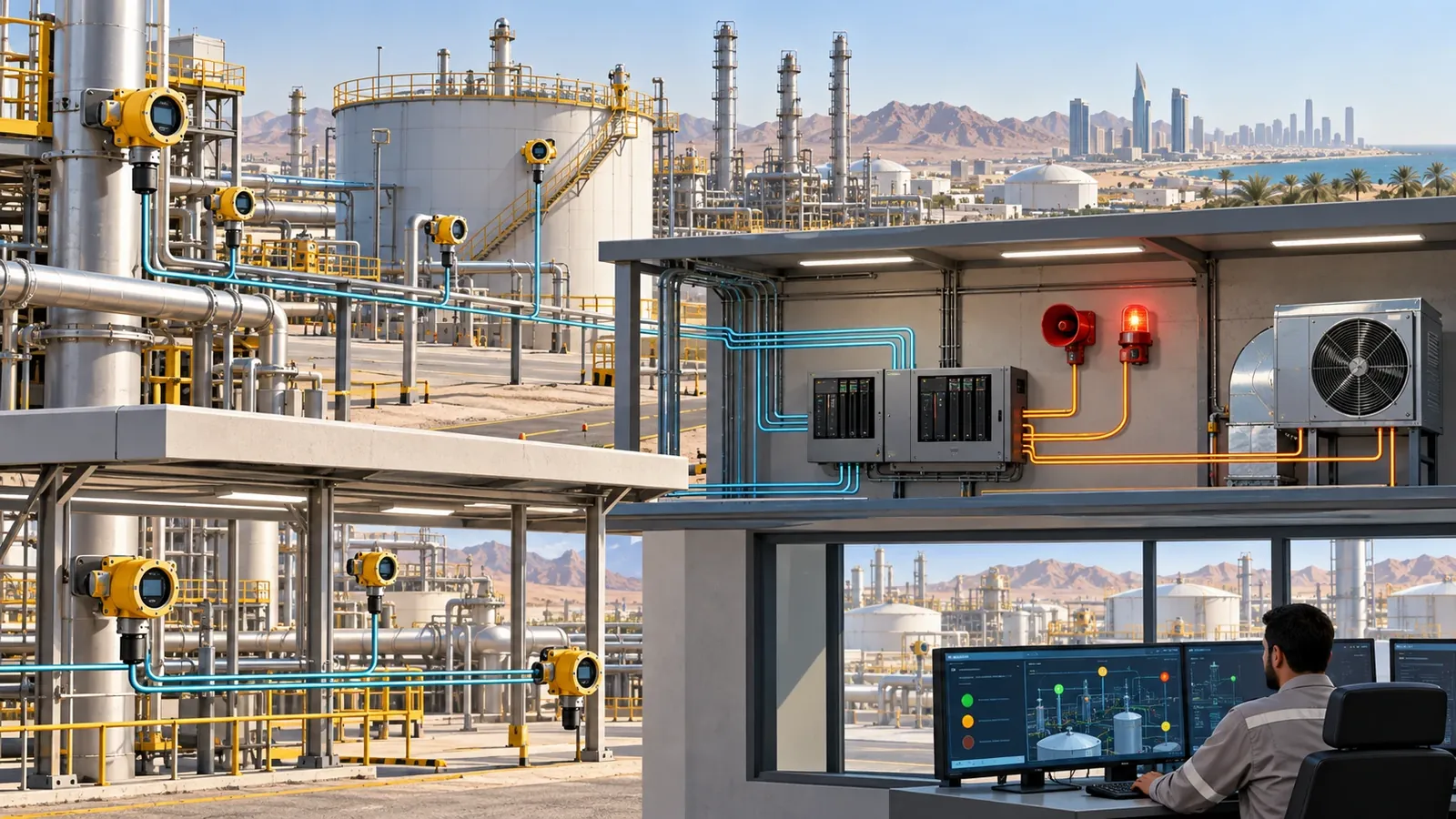
Fixed detectors may be required near process equipment, chemical storage, boiler rooms, wastewater areas, battery rooms, utilities or occupied-space interfaces. Selection begins with the target gas and hazard, expected range, sensor technology, location, ventilation, area classification, environmental conditions and required signal or network interface.
Detector placement is an engineering decision. Gas density alone is not enough; release points, temperature, pressure, ventilation, obstructions, access, maintenance and the consequence of a missed event also matter. The plant’s safety and process engineers remain responsible for the detection philosophy and approved design.
Portable and personal gas detection
Honeywell’s wider gas-detection portfolio includes portable and personal product routes for worker and field use. A portable detector may support pre-entry checks, personal monitoring or task-based measurements only when its sensor set, certification, alarms and procedure match the hazard assessment.
Portable safety readings should not be confused with an odour patrol or community-impact survey. Worker alarms, occupational limits and emergency actions have a different purpose from nuisance thresholds or sensory observations. Where both are needed, use separate procedures and records.
Controllers, alarms and integration
A complete fixed system may include detectors, local transmitters, controllers, audible and visual alarms, relays, network interfaces, power supplies and connections to approved plant systems. The proposal should identify which components are included and who is responsible for configuration, logic, shutdowns, cybersecurity, testing and ongoing proof checks.
Monitoring data can be displayed in an operating system, but the controls contractor and responsible safety engineers retain the approved control and safety lifecycle.
Gas and sensor selection
The target may include toxic, flammable or oxygen-related hazards. Each requires the appropriate sensing principle, range and certification. Environmental conditions, poisoning or inhibition, cross-sensitivity, humidity, temperature, sample transport and maintenance access affect selection. The exact Honeywell datasheet and certification should be checked for the proposed model and region.
For odour-specific hydrogen-sulfide, ammonia, sulfur or VOC diagnosis, the odorous-gas solution may define a different measurement range and data purpose. The oil, gas and petrochemical application shows how diagnostic and safety questions can coexist without being merged.
Preparing a Saudi gas-detection enquiry
Provide the facility, gas list, ranges, hazard assessment, area classification, fixed or portable duty, quantity, mounting, environmental conditions, alarms, controller and signal requirements, power, applicable specification, certifications, testing needs, location and programme. Honeywell gas-detection products are available for projects across Saudi Arabia, including Dammam, Jubail, Riyadh and Jeddah.
The quotation should state the exact detector, sensor, accessories, controller or interface, calibration kit, test equipment, spares and documentation rather than relying on a family name.
Submit these gas-detection requirements for an RFQ.
Frequently asked questions
Who supplies Honeywell gas detection in Saudi Arabia?
Saudi Odour Monitoring supplies selected Honeywell gas-detection products for each project. Honeywell’s official gas-and-flame-detection page describes a broad range for industrial facilities, including gas detectors, flame detectors and natural-gas alarms.
Is a gas detector the same as an odour monitor?
No. A safety detector addresses a defined hazard and alarm action. Odour monitoring may address nuisance, source diagnosis or control performance at different ranges and with different evidence.
Can portable instruments be used for confined-space entry?
Only when the selected instrument, certification, sensors, procedure, bump testing and calibration meet the employer’s approved confined-space programme.
Who is responsible for shutdown logic?
The plant’s process, controls and safety engineers are responsible for cause-and-effect, voting, interlocks, overrides, fail-safe states, testing and approval.
How do I buy Honeywell gas detection in Saudi Arabia, and what should my RFQ include?
Provide gases, ranges, safety duty, area classification, fixed or portable quantity, alarms, controller, outputs, certifications, environmental conditions, testing and programme.
What affects the cost of Honeywell gas detection?
Cost depends on the detector type and quantity, target gases and ranges, certification and area classification, controllers and interfaces, calibration and test equipment and spares. Your quotation sets these out.
How long does Honeywell gas detection delivery take?
Timing depends on the model, quantity, certification requirements and accessories. Lead time is confirmed in each quotation.
Saudi Odour Monitoring serves projects across Saudi Arabia, including Dammam, Al Khobar, Jubail, Riyadh, Jeddah, NEOM and Qiddiya.
For a Honeywell gas detection supplier in Saudi Arabia, send your gas list and safety duty and Request a quotation.