
Odour Monitoring Equipment Specification in Saudi Arabia
A strong odour monitoring equipment specification for a project in Saudi Arabia describes the decision the system must support, not only a list of sensors. If an RFQ asks for “an odour monitor with dashboard” without naming sources, target gases, ranges, locations, evidence use or response workflow, suppliers will make different assumptions and their offers will be difficult to compare.
Saudi Odour Monitoring supplies odour monitoring equipment and helps define the procurement basis for projects across Saudi Arabia. You receive a written proposal setting out the configuration, scope, lead time and price. Request a quotation
The specification should give bidders enough site and performance context to propose a complete, maintainable system while leaving room for justified alternatives. It should also separate equipment procurement from formal study terms of reference, laboratory analysis and dispersion modelling.
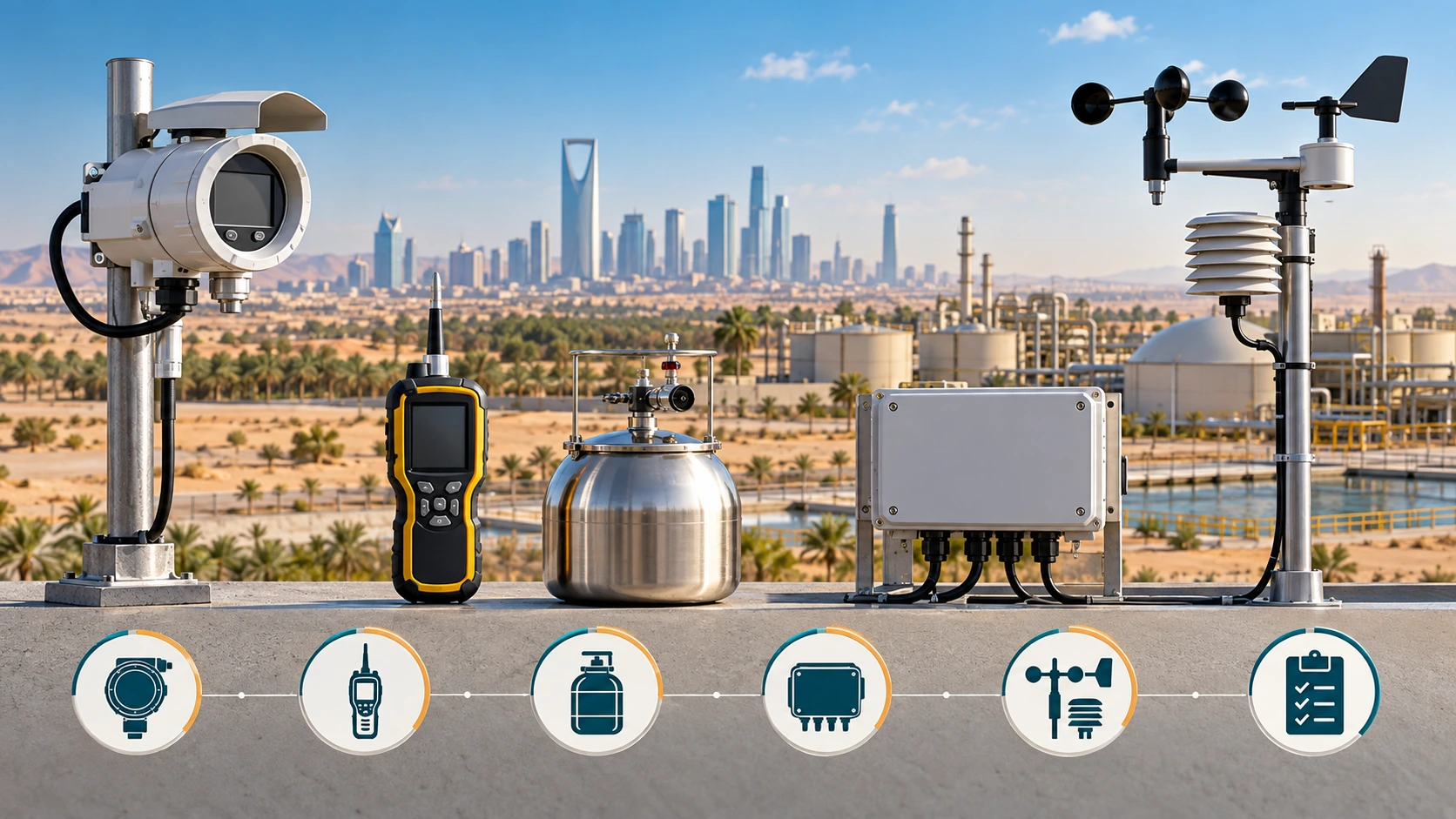
1. Odour monitoring equipment specification: state the objective and use
Describe the problem: recurring community complaints, source screening, wastewater H2S events, landfill boundary trends, control-system performance or portable investigation. Identify users and actions. Will data prompt an inspection, support a maintenance decision, trigger targeted sampling or feed a verified control workflow?
State whether the output is operational screening, internal reporting or intended for a formal submission. Name the applicable project standards and authority requirements where already established. Do not ask a supplier to infer a regulatory method from the word “compliance.”
The site odour screening and monitoring plans service can help define this procurement basis.
2. Describe sources, locations and conditions
Provide a layout, candidate points, source types, receptor areas and relevant process schedule. State whether each point is a stack or vent, process area, boundary, sewer/manhole, indoor space or portable survey location. Include expected access restrictions and hazardous-area classification where applicable.
List the environmental envelope: temperature, direct sun, dust, humidity or salt, washdown, flood risk, vibration and corrosive substances. Describe available power, cellular or network coverage, mounting structures and safe maintenance access. Ask bidders to state deviations and any required shade, shelter, conditioning or civil work.
3. Define targets, methods and performance
List target gases or response types, expected background and peak ranges, required time resolution, detection needs and known interferences. If the mixture is uncertain, request an initial diagnostic phase rather than arbitrary sensors. A total-VOC, H2S, compound-specific or electronic odour response should be named accurately; they are not interchangeable.
Require bidders to state measurement principle, range, resolution, response time, accuracy or uncertainty as applicable, environmental compensation, cross-sensitivities, warm-up, inlet and sample path. Ask which claims apply to the complete configured system versus an individual sensor under laboratory conditions.
Where formal dynamic olfactometry or VOC speciation is needed, specify laboratory coordination separately. Equipment suppliers should not represent live sensor data as accredited laboratory analysis.
4. Specify station, power and communications
Define enclosure, mounting, inlet, sampling pump, filtration, conditioning, local display, security and cable requirements. Request rated operating and storage limits for the complete bill of materials. If solar or battery power is proposed, require an energy budget, autonomy basis and battery environmental limits.
For communications, state available network options and cybersecurity responsibilities. Require local buffering, time synchronisation, retry behaviour, data recovery after an outage and a visible communications-health status. “Cloud connected” is not a complete interface specification.
If software is included, identify device count, user roles, maps, trends, exports, reports, alarms, retention, backups, hosting, licences and support term. The Scentroid SIMS3 and OdorMap software page is one product route; exact device compatibility and commercial tiers must be confirmed.
5. Define data, alarms and integration
Specify units, timestamps, time zone, raw and processed fields, diagnostics, data-status labels and metadata. Ask for an export sample and point list. If an API or integration is required, name the direction, authentication, format, update rate, ownership and acceptance test rather than requesting “open integration.”
For each alarm class, define the condition, persistence, recipients, acknowledgement, escalation and return-to-normal logic. Separate concentration alerts from instrument faults, maintenance due and communications loss. If monitoring data could influence control equipment, controls engineers must approve logic, interlocks and safety.
6. Include QA/QC and lifecycle support
Request factory documentation, commissioning checks, calibration or field-verification method, reference materials, consumables, filter schedule, preventive maintenance, recommended spares and expected sensor replacement. Define who performs each task and what training is included.
Do not use “self-calibrating” or “maintenance free” without a precise explanation. Ask for traceability and certificates only where relevant, and distinguish field checks from accredited calibration. Require a data-quality and maintenance audit trail.
The selected odour and VOC products hub can support comparison after the performance basis is defined. Model selection should follow the specification, not lead it.
7. Make acceptance and handover testable
List document submittals, drawings, configuration sheets, factory tests, site tests and training. At commissioning, confirm installation, flow, applicable zero/span checks, clock, communications, local storage, dashboard points, alarms and outage recovery. Record punch-list ownership and closure evidence.
Handover should include asset register, manuals, configuration backup, user roles, certificates where applicable, maintenance schedule, spare list, support contacts and responsibility matrix. Ask suppliers to price options and exclusions transparently so technical comparison does not depend on assumptions.
Frequently asked questions
How do I write an odour monitoring equipment specification for a Saudi project?
State the objective, sources, locations, environmental envelope, targets, ranges, data and acceptance tests. Select target gases using process knowledge, complaint character, source materials, prior data and the decision required; when uncertainty is high, specify a diagnostic phase before finalising the permanent sensor panel.
Should an RFQ name a specific odour-monitor model?
It can name an approved basis-of-design model, but still state the required outcome and configuration. If alternatives are allowed, require a point-by-point compliance and deviation schedule.
How should bids be compared?
Use a compliance matrix covering technical fit, limitations, lifecycle, data, integration, commissioning, training, warranty, support, exclusions and total scope—not headline sensor count alone.
Is an equipment specification the same as an odour-study scope?
No. It defines the system to be supplied and accepted. A formal study scope additionally defines methods, sampling design, modelling, laboratory work, reporting and professional approval.
Who provides odour monitoring equipment in Saudi Arabia?
Saudi Odour Monitoring supplies odour monitoring equipment for each project and helps define the specification. Configuration, availability and lead time are confirmed in each quotation.
What affects the cost of an odour monitoring system?
Cost depends on the target gases, number of stations, enclosure, power and communications, software scope, calibration and support requirements. Your quotation sets these out.
How long does odour monitoring equipment delivery take?
Timing depends on the configuration, number of stations, software scope and commissioning requirements. Lead time is confirmed in each quotation.
Saudi Odour Monitoring serves projects across Saudi Arabia, including Dammam, Al Khobar, Jubail, Riyadh, Jeddah, NEOM and Qiddiya.
For an odour monitoring equipment specification and quotation in Saudi Arabia, Request a quotation.