
Measuring the Performance of Odour-Control Systems
This guide explains how to check odour control system performance in Saudi Arabia, meaning whether an odour-control system delivers the intended result, because a system can be running without doing so. A fan-status signal confirms that a motor was commanded or operating; it does not prove capture, treatment or reduced impact at a receptor. Performance monitoring should connect process conditions, inlet and outlet evidence, equipment health and downstream outcomes.
Saudi Odour Monitoring provides performance monitoring and workflow integration for odour-control systems across Saudi Arabia. You receive a written proposal setting out the scope, lead time and price. Request a quotation
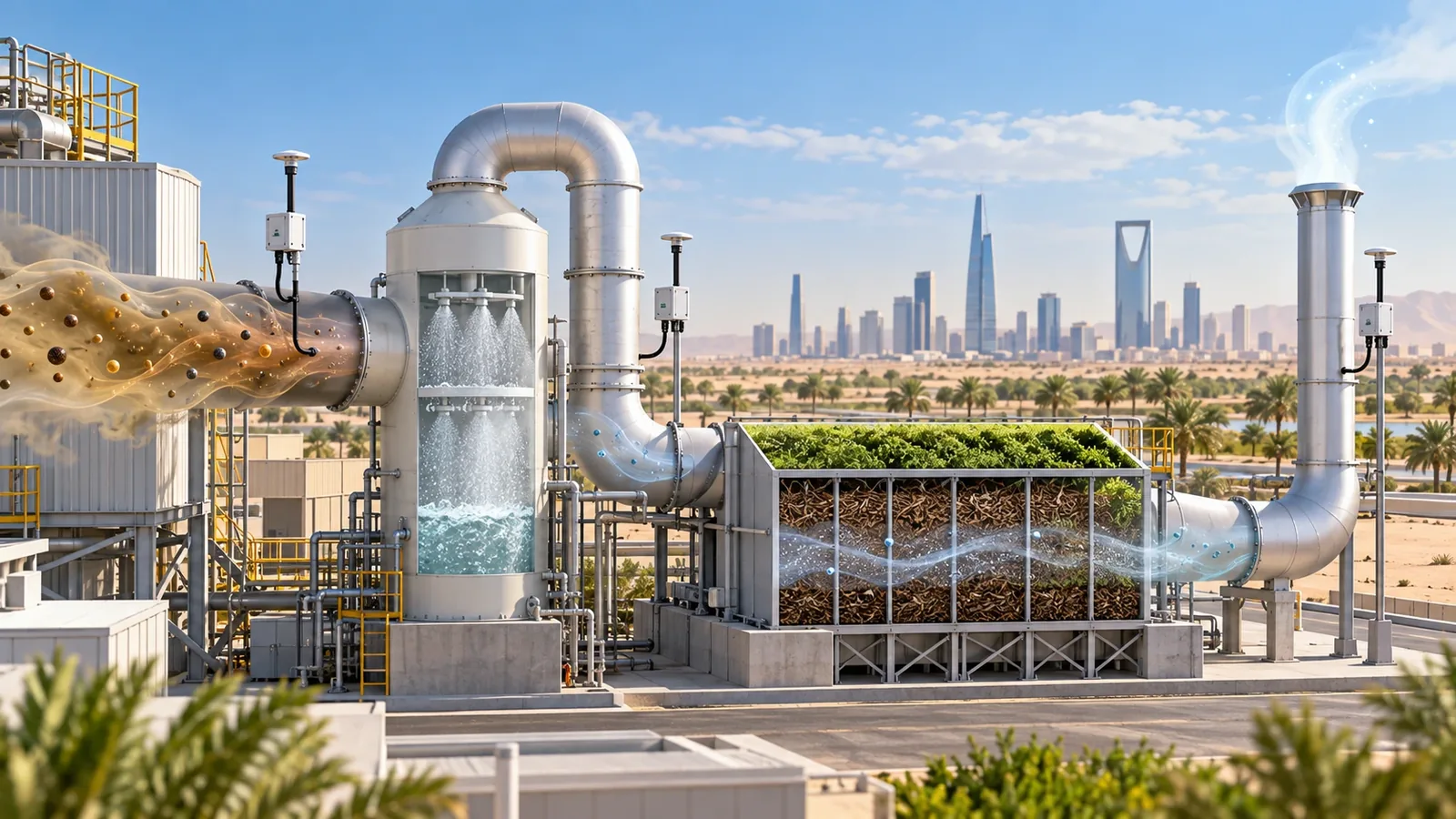
This applies to chemical scrubbers, activated carbon, biofilters, adsorption or filtration stages, covers and extraction systems, and combined treatment trains. The measurement plan should follow the control mechanism and decision. A wastewater operator checking H2S removal needs different evidence from a rendering facility comparing a complex odour mixture.
Define performance before collecting data
Write the expected outcome in measurable terms. It may be lower H2S at the outlet, reduced odour concentration under comparable loading, fewer boundary events, stable differential pressure or evidence that capture operates during a production stage. Separate process indicators from outcome indicators.
Process indicators might include airflow, pressure drop, liquid flow, pH, oxidant or reagent condition, media state, temperature, moisture and fan or pump status. The relevant list depends on the technology. Outcome indicators may include target-gas concentrations, broad odour or VOC signals, dynamic-olfactometry results, field observations and community-event patterns.
The odour-control performance and automated system activation solution is the commercial route for measurement and verified workflows. This article does not design the control equipment or guarantee its removal efficiency.
Establish comparable inlet and outlet conditions
Removal efficiency is meaningful only when inlet and outlet measurements represent the same operating condition and use compatible methods. Account for residence time between points. Record process load, flow, temperature, moisture, bypass position and control settings. If the source changes during sequential sampling, the calculated difference may reflect operations rather than treatment.
Continuous sensors can show transient performance and breakthrough. Source samples with qualified laboratory analysis may be needed when the target is odour concentration or a specific compound beyond the sensor method. Sampling points should be safe, accessible and designed for representative collection; a convenient port is not automatically suitable.
Keep units, wet/dry basis, reference conditions and averaging periods aligned. If concentration falls because clean air entered through leakage or dilution, that is different from mass removal. Flow information may be necessary when the decision concerns emission rate rather than concentration alone.
Add process and equipment-health evidence
Trend the process variables that explain treatment. For a scrubber, this may include recirculation, pH, reagent condition, pressure and liquid distribution. For a biofilter, moisture, temperature, pressure and airflow distribution may matter. For carbon or other media, pressure, operating time and breakthrough indicators may support change-out decisions.
The system designer or responsible process specialist should specify the variables, acceptable ranges and maintenance actions. Monitoring providers should not invent control setpoints. Instrument faults, calibration periods and communications loss need separate flags so a missing outlet reading is not mistaken for zero emissions.
Alarm logic should state the input, delay, persistence, recipient and required response. If data will activate equipment automatically, the responsible controls engineer must approve logic, interlocks, authority, fallback states and safety. The odour system and control-workflow integration service coordinates interfaces without taking unsupported control responsibility.
Check the outcome beyond the outlet
Good outlet performance may not resolve complaints if capture is poor, doors or covers leak, another source dominates or the discharge pathway is unsuitable. Add inspections of containment and extraction, selected area or boundary measurements, weather, field observations and complaint review where relevant.
Compare like with like. A before/after study should cover comparable production, feed, weather and operating conditions and enough repeated periods to represent variability. Document maintenance or process changes during the comparison. One favourable sample is not proof of sustained control.
For formal source odour results, use planned sampling and a qualified dynamic-olfactometry laboratory. For compound-specific evidence, use an appropriate analytical method and qualified laboratory. The dynamic olfactometry and panel support service is the coordination route.
How to check odour control system performance: a report operators can use
The report should state the control objective, technology, monitoring points, methods, operating conditions, data coverage, maintenance, exclusions and limitations. Show inlet, outlet and key process variables on a common timeline. Explain whether reported reduction is concentration-based, mass-based, sensory or an operational indicator.
Assign corrective actions and owners. A report that only calculates an average cannot show whether a media change, blocked line, dosing fault or capture problem needs attention. Preserve raw data and configuration changes so future comparisons remain defensible.
This work measures odour-control outcome. Resource efficiency, energy, chemical use and carbon performance are separate questions that may use the same operating data but need their own metrics and ownership.
Frequently asked questions
How do I check odour control system performance on a Saudi site?
There is no single best measure. Use the target pollutant or sensory outcome, process indicators and downstream evidence that match the control mechanism and project objective. Outlet concentration alone may not be enough for removal efficiency: inlet and outlet conditions, timing, flow, moisture, units and dilution must be compatible.
Who provides odour control performance monitoring in Saudi Arabia?
Saudi Odour Monitoring provides the monitoring approach, instrumentation coordination and reporting for odour-control systems. Source odour analysis is performed by a qualified laboratory under the applicable method.
What affects the cost of odour control performance monitoring?
Cost depends on the control technology, number of monitoring points, sensors and process indicators, any laboratory sampling, integration needs and reporting. Your quotation sets these out.
How long does odour control performance monitoring take?
Duration depends on source variability, the comparison design and the strength of conclusion needed. A before-and-after comparison should cover representative loading, operation and weather; one favourable day is rarely enough.
Can continuous sensors detect control breakthrough?
They may show a rising outlet trend or changing inlet/outlet relationship when the target is within their capabilities. Confirm range, interference, response and maintenance before relying on the alert.
Can monitoring data automatically start odour control?
It can provide a verified input to an approved control workflow. The controls engineer must define logic, interlocks, fail-safe behaviour and responsibility; monitoring alone does not authorise control.
When is dynamic olfactometry appropriate?
Use it when the decision concerns odour concentration of source samples. Sampling and analysis should be planned with a qualified laboratory under the applicable method.
Saudi Odour Monitoring serves projects across Saudi Arabia, including Dammam, Al Khobar, Jubail, Riyadh, Jeddah, NEOM and Qiddiya.
To plan how to check odour control system performance, Request a quotation and we will set out the monitoring points and scope.