
Fenceline Odour Monitoring in Saudi Arabia
Saudi Odour Monitoring supplies and designs fenceline odour monitoring in Saudi Arabia for industrial facilities, wastewater works, waste sites and other operations that need better evidence around recurring odour concerns. Fenceline monitoring connects conditions at an operating site with what may be experienced beyond its boundary, with the siting logic adapted to each facility, neighbouring land use and local wind regime. The service combines source knowledge, fixed or portable monitoring, weather and community-event records. You receive a written proposal setting out the configuration, scope, lead time and price. Request a quotation
The design starts with the question. A site may need early warning when a plume approaches a boundary, evidence around a particular wind sector, comparison between source-side and receptor-side conditions, or a clearer response to complaints. Those are different objectives and may require different locations, sensors and data-review rules.
From sources to receptors
We map priority sources, boundary access, neighbouring land uses and sensitive receptors such as homes, schools, healthcare facilities or workplaces. We also review prevailing and seasonal winds, local buildings, terrain and coastal influences where relevant. In locations such as Jeddah, Jubail, Yanbu or Dammam, changing sea and land breezes may make a single “downwind” position insufficient.
A source-near monitor can provide early warning but may not represent boundary conditions. A fenceline unit can record passage at one point but may miss another wind direction. A community-side location can be useful when access, security, utilities and representation are acceptable. The network therefore needs a siting rationale rather than evenly spaced instruments with no defined purpose.
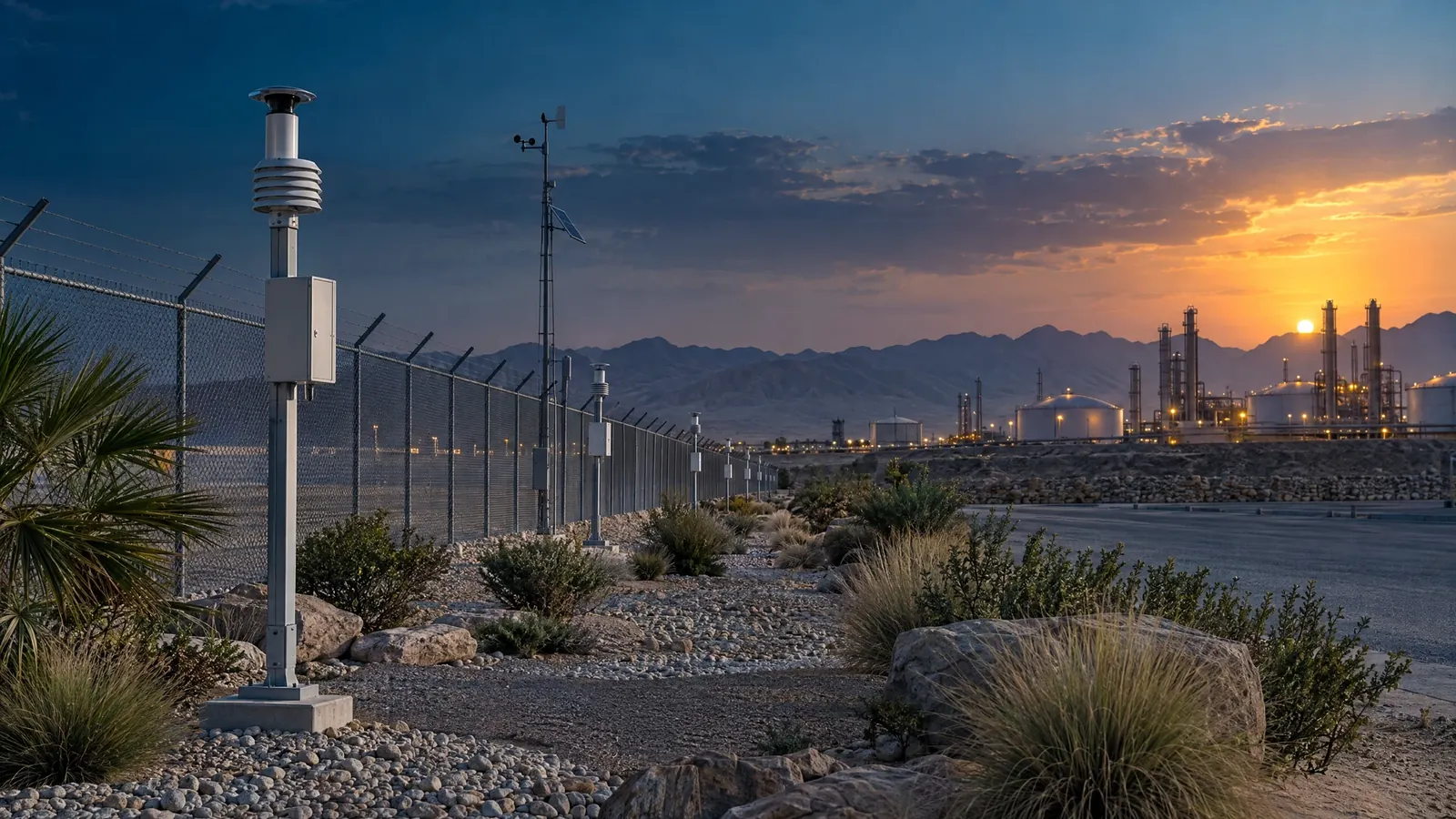
Fenceline odour monitoring equipment we supply in Saudi Arabia
The Scentroid SL50 is one fixed platform we supply for selected applications. Scentroid describes up to 20 sensing modules, with technologies including electrochemical, PID, NDIR and particulate sensing, plus communications and SIMS3 connection (Scentroid SL50). A project does not need every module. Sensor selection follows the likely compounds, concentration range, humidity, temperature, dust and potential cross-sensitivities.
Wind speed and direction help determine whether a monitor was plausibly influenced by the site during an event. Temperature and humidity can support sensor interpretation, while rainfall, stability and local obstructions may also matter. Facility operating records—such as loading, treatment state, maintenance, cleaning, control status or abnormal conditions—add another independent layer.
For data handling, SIMS3 is described by its manufacturer as providing historical data, alarms, mapping, event logs and complaint-management functions (Scentroid SIMS3). These features can help assemble an event chronology. They do not automatically establish cause, impact or compliance.
Combine community reports with measured events
A consistent complaint or observation record should include time, location, duration, character and perceived intensity. Our odour complaint investigation and response planning service can define intake and response steps. Comparing reports with monitoring, weather and operations may reveal recurring wind sectors or operating states, or show that more evidence is needed.
When a fixed sensor cannot distinguish a complex mixture, a patrol or targeted sample may be appropriate. A field olfactometry and odour-patrol programme can establish repeatable routes and observations. A documented odour-source sampling strategy can then support analysis by a qualified laboratory. Field observations, sensor values and dynamic olfactometry results are different evidence types and should not be presented as interchangeable.
Operational reporting without overclaiming
The reporting plan can define valid-data checks, event criteria, wind filters, data completeness, instrument status, complaint correlation and review frequency. The US EPA Air Sensor Toolbox notes that sensor use should be planned and evaluated for the intended application (US EPA Air Sensor Toolbox). We therefore label the role of each monitor and avoid treating indicative results as reference or regulatory measurements without a suitable project method.
A useful output may include event summaries, mapped observations, wind-sector patterns, source inspections and recommended next tests. It should also document gaps, uncertain periods and alternative explanations. Where formal off-site impact assessment or dispersion modelling is required, odour dispersion and source-attribution support can coordinate a qualified specialist under a separate scope.
Network upkeep is part of evidence quality in practice. The operating plan can assign enclosure and inlet inspections, status reviews, verification records, communications checks and maintenance notes. Relocated units and configuration changes should be time-stamped so analysts know which location and setup produced each value. These controls make later event reconstruction more dependable.
Saudi Odour Monitoring can support equipment supply, siting, deployment planning, dashboards and operating handover. Equipment supply does not replace the permit, approved method or regulatory decision that applies to your project. To request a scope, share the site layout, source list, boundary constraints, nearby receptors, past reports and available utilities through our contact page. Request a quotation for fenceline odour monitoring in Saudi Arabia.
Frequently asked questions
How do I choose fenceline odour monitoring locations?
Locations follow the source map, wind sectors, boundary geometry, receptor positions, access, security, utilities and the exact question. Placement should be justified, not based only on equal spacing.
Who provides fenceline odour monitoring in Saudi Arabia?
Saudi Odour Monitoring supplies fixed modular gas monitors, weather sensors, communications, dashboards and portable screening or sampling equipment for follow-up. Final configuration is site-specific.
What affects the cost of fenceline odour monitoring?
Cost follows the number of monitoring positions, the sensor modules and ranges, weather and communications options, dashboards and the deployment period.
How long does fenceline monitoring take to set up?
Timing depends on the network design, site access, utilities and the equipment configuration. Lead time is confirmed in the quotation.
Can one fenceline monitor cover the entire boundary?
Usually not under all wind conditions. One monitor may be useful for a defined source or sector, but broader coverage may need multiple positions, mobile checks or phased deployment.
Can community complaints be displayed with monitoring data?
Yes, subject to the selected software, privacy controls and reporting design. A mapped complaint remains an event report and does not independently prove the site was the source.
Is fenceline sensor data automatically regulatory evidence?
Saudi Odour Monitoring serves projects across Saudi Arabia, including Dammam, Al Khobar, Jubail, Riyadh, Jeddah, NEOM and Qiddiya.
No. Regulatory use depends on the applicable requirement, method, quality plan and authority expectations. Indicative sensors should be described according to their established performance and intended use.