
Landfill and Compost Odour Monitoring in Saudi Arabia
Saudi Odour Monitoring supplies landfill and compost odour monitoring in Saudi Arabia for landfill, composting, transfer, recycling and treatment facilities. Waste-site odour can move as working areas, material condition, wind and operating activities change, so we build monitoring around those changes. We combine source mapping, fixed or portable instruments, weather, field observations, complaint records and targeted sampling when needed. You receive a written proposal setting out the configuration, scope, lead time and price. Request a quotation
The programme can investigate recurring community reports, compare operating zones, provide early warning in priority wind sectors or check the consistency of an odour-control measure. The scope states what each data stream can show. It does not assume that one sensor measures every odorant or that every off-site report originates at the facility.
Map a changing source environment
Potential sources depend on the operation. At landfills they may include the working face, recently placed waste, leachate areas, gas-collection features, exposed or disturbed zones and waste handling. At compost sites they may include reception, mixing, active processing, turning, curing, storage, leachate and drainage. Transfer or treatment facilities may add tipping halls, doors, extraction points, containers and residues.
The source register should record operating hours, material types, daily movement, process state, controls and abnormal events. Monitoring positions may need to change as the active area moves. Safe access, vehicle routes, power, communications, dust, heat and equipment security are part of the design.
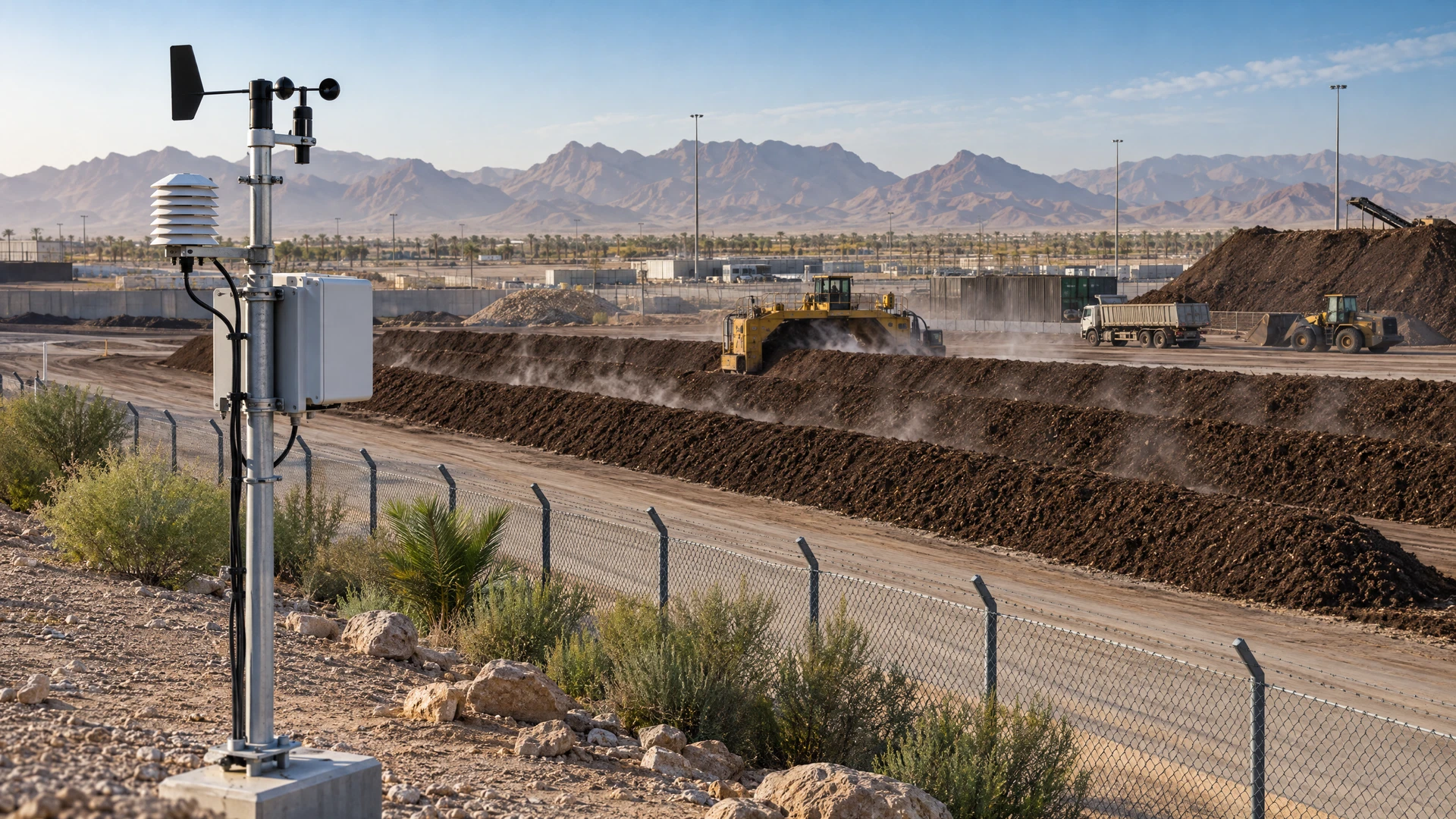
Landfill and compost odour monitoring equipment we supply
A fixed network can track selected gas or proxy signals through day and night. The Scentroid SL50 is one modular platform we supply. Its manufacturer describes up to 20 sensing modules, multiple sensor technologies, communications and SIMS3 connectivity (Scentroid SL50). The appropriate modules depend on the source hypothesis, expected range and field conditions.
Deployment design should anticipate operational movement. The site can retain one or more reference locations while relocating selected units as cells, compost rows or storage zones change. Every move, inlet adjustment and sensor configuration should be logged. That history prevents measurements from different layouts being compared as though conditions were unchanged.
A portable instrument such as the Scentroid TR8 OdoTracker can support GPS-linked surveys around active zones, boundaries and receptors. Scentroid describes configurations with up to two chemical sensors plus temperature and humidity logging (Scentroid TR8). Portable readings can locate patterns and guide inspection, but broad sensor response does not identify an entire odour mixture.
Meteorology is essential for outdoor interpretation. Wind direction and speed help establish potential pathways, while temperature and changing stability can affect dispersion. Operations and weather should be reviewed together: turning compost, opening a tipping hall, handling leachate or disturbing waste may matter only under certain conditions.
Link community events with field response
Our odour complaint investigation and response planning service can standardise the location, time, duration, character and perceived intensity captured for each report. A mapped complaint is an event record, not automatic source proof. Staff can check wind and operations, inspect priority zones and conduct a defined patrol.
The field olfactometry and odour-patrol service can create consistent routes and observation points around a changing operation. If chemical identity or odour concentration matters, odour-source sampling strategy can define targeted collection for a laboratory. Dynamic olfactometry and chemical analysis are external laboratory activities, not replaced by portable readings.
The UK Environment Agency’s odour guidance offers a general planning principle: consider odorous releases, potential effects on people and measures to prevent or reduce them (UK Environment Agency). It is cited as a practical reference, not as Saudi law. Any Saudi licence, permit or regulator reporting requirement must be established separately for the facility.
Support operating decisions
Deliverables can include the source register, phased siting plan, equipment schedule, survey route, data-quality routine, complaint-response workflow and event-report template. Reviews may compare patterns by source zone, wind sector, time of day, material condition or activity. Uncertain events and missing data should be shown rather than forced into a conclusion.
The review frequency can reflect the operation: rapid checks during a new campaign or process change, followed by routine summaries once the response workflow is stable.
Our monitoring is available for projects across Saudi Arabia, including municipal and industrial waste facilities in Riyadh and Jeddah and operating areas around Dammam, Jubail and other regions.
Monitoring may support inspection of cover practices, gas collection, drainage, doors, extraction, biofilters or other controls. Monitoring does not treat odour or certify that a control is compliant. Final operational changes remain with the operator and its waste, process, safety and controls personnel.
For the broader sector workflow, visit waste, landfill and compost odour applications. To request a site-specific scope, send the layout, active zones, operating schedule, waste or feedstock types, controls, complaint history and nearby receptors through our contact page. Request a quotation for landfill and compost odour monitoring in Saudi Arabia.
Frequently asked questions
How do I choose landfill and compost odour monitoring for my facility?
The approach can be adapted to landfills, composting, transfer stations, recycling, organic-waste processing and related treatment facilities, subject to the process and safe access.
Who provides landfill and compost odour monitoring in Saudi Arabia?
Saudi Odour Monitoring supplies fixed modular monitors, portable gas instruments, weather sensors, dashboards and odour-sampling equipment. Configuration follows the likely sources and site conditions.
What affects the cost of landfill and compost odour monitoring?
Cost follows the number of monitoring positions, the sensor modules and ranges, weather and communications options, relocation needs as the working area moves, and any sampling or laboratory work.
How long does landfill and compost odour monitoring take to set up?
Timing depends on the facility layout, safe access, power and communications, and the equipment configuration. Lead time is confirmed in the quotation.
Can monitor locations change as the working face moves?
Yes. A phased plan can identify fixed reference points and relocatable positions. Changes should be documented so trends are interpreted against the actual deployment layout.
Can monitoring distinguish landfill odour from another nearby source?
It can contribute through spatial patterns, wind, operating records, odour character and targeted chemistry. Competing sources may require repeated observations or specialist analysis before attribution.
What happens when an odour event is detected?
Saudi Odour Monitoring serves projects across Saudi Arabia, including Dammam, Al Khobar, Jubail, Riyadh, Jeddah, NEOM and Qiddiya.
The agreed plan may trigger device checks, wind and operations review, field inspection, portable screening or a targeted sample. Site management decides corrective actions under its operating procedures.