
Fenceline Odour Monitoring for Industrial Facilities
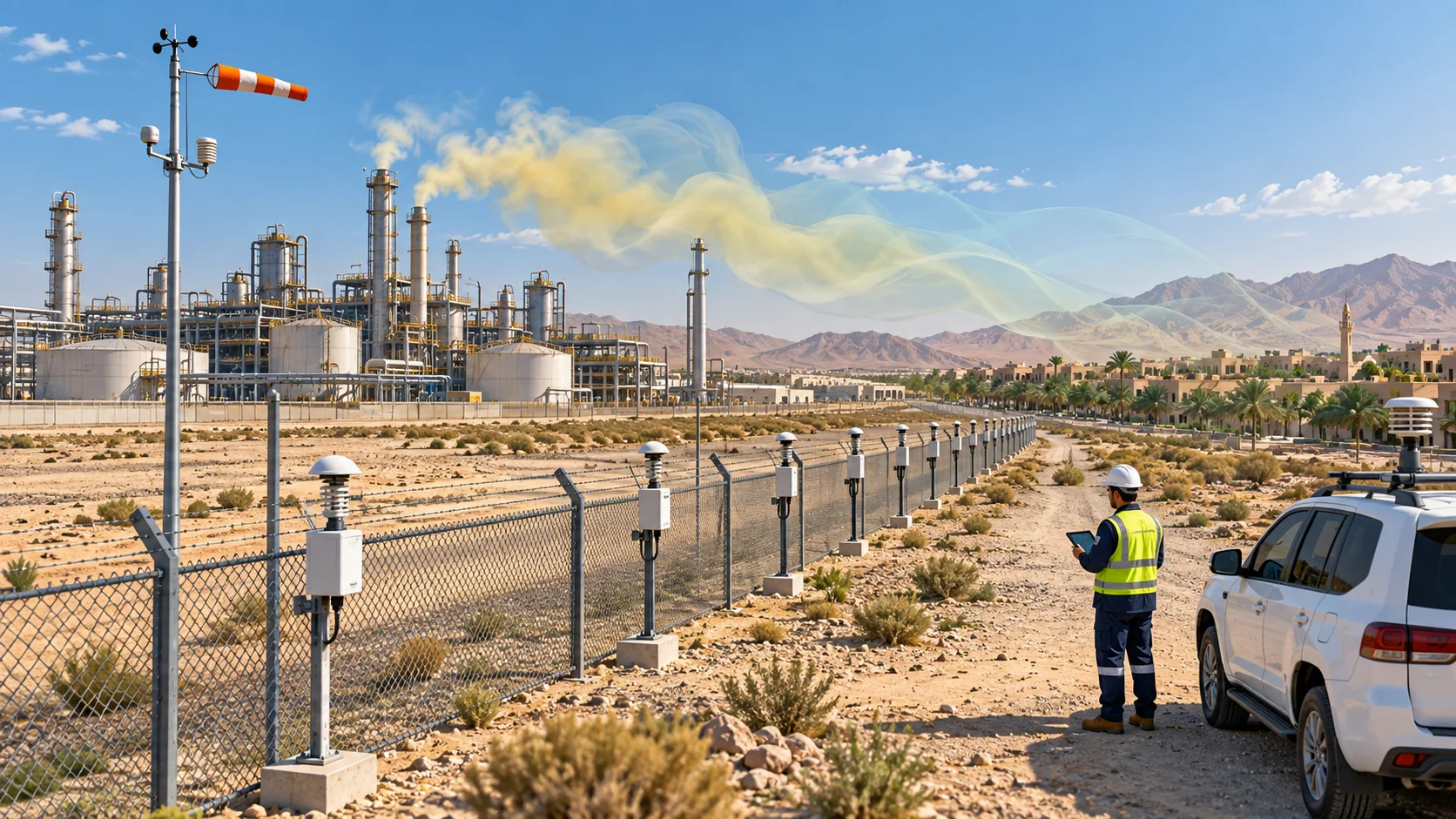
This guide explains how to monitor odour at an industrial site boundary in Saudi Arabia, with stations sitting between the process and the community. It can show when odour-related gases or mixture indicators reach selected boundary locations, how patterns change with wind and operations, and where follow-up is justified. It cannot, on its own, reproduce every human perception or prove that one source caused an event.
The strongest programmes begin with a clear question. A refinery may need to distinguish sulfur-related events from VOC patterns; a food or rendering facility may need to compare production stages; a wastewater or waste site may need to understand short, intermittent releases. The target compounds, sensor methods and station layout should follow that question. You receive a written proposal setting out the configuration, scope, lead time and price. Request a quotation
Define what the fenceline system should decide
Write the intended actions before choosing hardware. The system might provide early warning to an environmental team, correlate community complaints, identify a recurring wind sector, trigger a source-area inspection or compare conditions before and after maintenance. Each use needs a different combination of measurement range, time resolution, alert logic and record keeping.
Separate operational screening from formal compliance measurement. An electronic odour or broad VOC signal may be valuable for trends but may not satisfy a compound-specific or prescribed method. An H2S sensor can be highly relevant at a sulfur source but does not represent all odour. Dynamic olfactometry measures a source sample through a qualified sensory laboratory; it is not a continuous boundary sensor.
The fenceline odour and community-impact monitoring solution is the commercial route for a configured network. This article remains an editorial planning guide and does not replace a regulatory study or approval.
How to monitor odour at an industrial site boundary: station layout
Map process areas, tanks, loading, wastewater interfaces, vents, storage, waste handling, control equipment and non-facility sources. Add nearby receptors, terrain, buildings, prevailing and seasonal winds, safe access, power and communications. A station should have a named role—source-side context, upwind comparison, community-facing boundary or investigation point.
Avoid calling one location permanently “upwind” or “downwind.” Wind changes, and obstructions can create local flow unlike the nearest weather station. A useful network may combine several fixed points with a representative meteorological station and portable follow-up. The number of stations should be justified by the objective and geometry, not copied from another site.
Inlets and sensors need protection without preventing representative sampling. Check height, nearby exhausts, walls, solar loading, dust, humidity, maintenance access and security. Document coordinates and photographs so a later move is visible in the data history.
Combine complementary evidence
Continuous sensors provide timing and trends. Weather supplies transport context. Operational records explain what the facility was doing. Complaint records and controlled field observations describe human perception at a location. Source samples and laboratory analysis answer different questions about odour concentration or compounds.
Align these streams to one clock and preserve raw data, health flags and maintenance periods. When an alert occurs, check the instrument before interpreting the environment. Then review wind, neighbouring stations, process activity and alternative sources. Repeated agreement among independent evidence is stronger than a single peak.
For compound-specific questions, VOC, BTEX and speciated-gas diagnostics provides the diagnostic route. Laboratory speciation must use an appropriate sampling and analytical method.
Design alerts as an investigation workflow
An alert should state the station, parameter, unit, time, averaging basis, data status and rule exceeded. Configure separate messages for instrument fault and communications loss. Define persistence and return-to-normal logic so a noisy signal does not create repeated unhelpful messages.
Assign a recipient and first action. That may include confirming station health, checking wind, inspecting a named process area and recording findings. Escalation should reflect the site’s operating and emergency procedures. A dashboard threshold is not automatically a legal odour limit, and an alert is not source attribution.
Review false, missed and repetitive alarms with a controlled change record. Do not quietly raise thresholds simply to reduce notifications. The odour source identification and attribution solution can structure deeper follow-up when patterns persist.
Keep the network maintainable
Before procurement, define expected ranges, known interferences, environmental envelope, calibration or verification, consumables, spare sensors, communications, data retention, user roles and service access. A low-maintenance claim should never replace a written lifecycle plan.
Reports should show availability, invalid periods, maintenance, alert response and unresolved limitations alongside concentration trends. Review station usefulness after operating changes or new neighbouring development. A fenceline network earns confidence through transparent limits and consistent response, not through a promise that every odour will be detected.
This odour-specific programme is distinct from a broad ambient air-quality network measuring criteria pollutants. It may share power, communications or weather infrastructure, but the questions, methods and interpretation are different.
Frequently asked questions
What should an industrial fenceline odour station measure?
Choose targets from process knowledge and the decision required. Options may include H2S, ammonia, selected sulfur compounds, VOC indicators, compound-specific analysers, electronic odour response and weather. No single panel suits every site.
How do I monitor odour at an industrial site boundary, and how many stations are needed?
The answer depends on source distribution, boundary shape, wind variability, receptors, access and the purpose of the data. Use a documented location study or staged deployment rather than a universal number.
Can an electronic odour sensor replace human observations?
No. It provides repeatable continuous response to the conditions it is designed for, while human observations describe perception and character. The methods are complementary and require their own quality controls.
Does a downwind peak identify the source?
It narrows the investigation but does not prove cause. Review station health, wind variability, site operations, other stations and possible external sources before drawing a conclusion.
Who provides fenceline odour monitoring in Saudi Arabia?
Saudi Odour Monitoring supplies configured fenceline odour monitoring networks for industrial facilities across Saudi Arabia.
What affects the cost of fenceline odour monitoring?
The number of stations, target compounds and ranges, meteorological station, communications and power, accessories and maintenance requirements. The price is set out in your quotation.
How long does it take to deploy a fenceline odour monitoring network?
It depends on the location study, station count, access and equipment lead time, and is confirmed in the quotation.
Saudi Odour Monitoring serves projects across Saudi Arabia, including Dammam, Al Khobar, Jubail, Riyadh, Jeddah, NEOM and Qiddiya.
To plan how to monitor odour at an industrial site boundary, send your site plan, sources and receptors. Request a quotation