
Human-Nose Methods vs Electronic Odour Sensors
Saudi Odour Monitoring designs electronic odour monitoring in Saudi Arabia alongside human-nose methods, because people experience odour through the human sensory system while electronic instruments respond to chemicals or trained signal patterns. That difference explains why neither method replaces the other. Human-nose methods can describe detection and perception directly. Instruments can collect repeatable, time-resolved signals without waiting for an observer. The right Saudi odour programme chooses each method for a defined question.
“Human-nose method” also covers several distinct activities: laboratory dynamic olfactometry, field olfactometry, trained odour patrols and community reports. “Electronic odour sensor” may mean a targeted H2S or NH3 sensor, a total-VOC detector or a multi-sensor pattern system. Comparisons are useful only when the exact methods are named.
We support sensory-method and electronic-monitoring programme design across Saudi Arabia. You receive a written proposal setting out the scope, configuration, lead time and price. Request a quotation
Dynamic olfactometry quantifies a collected sample
In dynamic olfactometry, an odour sample is diluted with neutral air and presented to selected panellists under a controlled method. Panel responses are used to calculate an odour-detection threshold and concentration. The result relates to the collected sample and analytical procedure, not to continuous conditions at the source or receptor.
Its strengths are a defined sensory endpoint, controlled dilution and standardised panel management. Its constraints include sample representativeness, bag compatibility, holding time, laboratory scheduling and the fact that it does not identify individual chemicals. Formal work should go through dynamic olfactometry and odour panel support.
Field sensory methods capture experience in context
Trained patrols can record whether odour is detected at a location, how intense it seems, its character, duration and weather context. A field olfactometer can present controlled dilutions of ambient air to one trained user under a defined procedure. Community reports add receptor experience, especially for short events that a scheduled visit misses.
These methods remain influenced by training, individual sensitivity, adaptation, expectation and safety constraints. A single observation should not be labelled a representative site concentration. Field olfactometry is also not the same as laboratory dynamic olfactometry under EN 13725. The field olfactometry and odour patrol planning route should state the chosen procedure and delivery model.
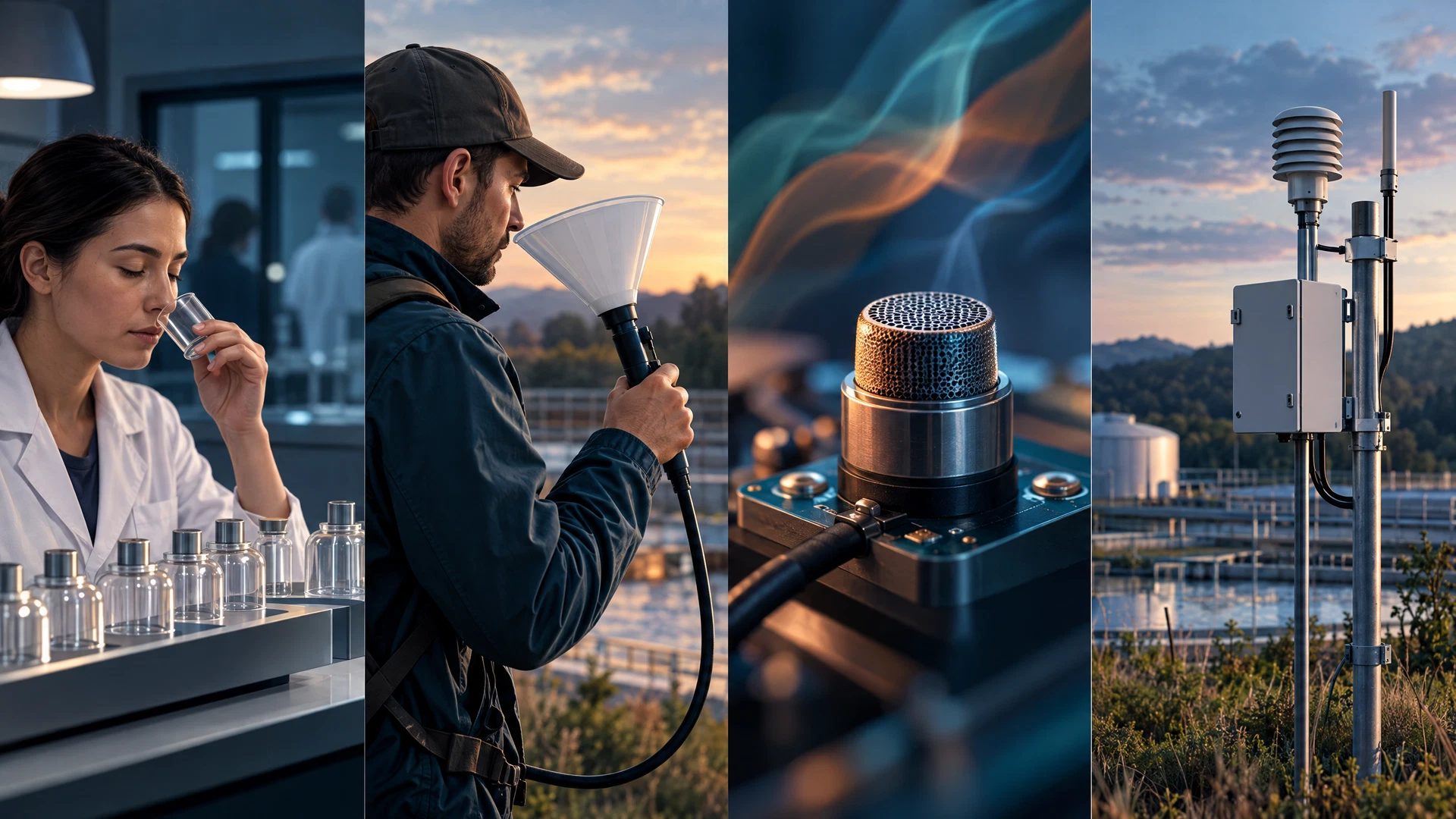
Electronic odour monitoring sensors for Saudi Arabia
A targeted gas sensor can record H2S, NH3 or another configured compound at short intervals. A PID may provide a total-VOC response across many ionisable vapours. A multi-sensor system may use a combination of responses and a trained model to estimate patterns associated with known odour conditions. Instruments can support alarms, trends, comparisons among locations and event follow-up.
An instrument does not experience pleasantness, offensiveness or character as a person does. Response can be affected by range, cross-sensitivity, temperature, humidity, drift, inlet design and the gas mixture. A total-VOC value does not reveal every compound. A pattern model should be evaluated against the source types and conditions where it will be used, particularly in Saudi heat, dust and coastal humidity.
Compare the question each method answers
Use dynamic olfactometry when a representative collected sample needs a method-defined odour concentration. Use a trained field observation when the question concerns perceived odour at a place and time. Use targeted sensors when a compound is a credible indicator and continuous timing matters. Use complaint records when the receptor experience and event distribution matter. Use compound-specific analysis when chemical identity or concentration is required.
The methods may disagree without one being “wrong.” A sensor can show H2S while the mixture’s overall odour changes little; a person can detect an odour that the installed target sensor does not measure; a bag sample can lose or transform components before analysis. Investigate the reason rather than forcing all streams onto one common scale.
A combined event workflow
A fixed station may first flag an H2S or VOC change. The response team reviews equipment status, wind and operations, then uses a portable instrument or documented patrol near likely pathways. Complaint records show whether receptors noticed the event. If a representative source sample is captured, a qualified laboratory can measure odour concentration or selected compounds.
Time synchronisation and metadata are essential. Record sensor status, observer location, route, adaptation break, weather, process state, sample details and uncertainty. The continuous odour monitoring systems page addresses the stationary measurement layer, while the Scentroid TR8 OdoTracker page describes a portable two-channel product option.
Avoid false equivalence in procurement
Do not ask an electronic sensor to “measure odour units” unless the manufacturer documents the model, training and validation basis for the exact application, and even then distinguish the estimate from laboratory dynamic olfactometry. Do not call an untrained complaint record a panel measurement. Do not use a person’s nose for safety clearance, especially for H2S, where smell can fatigue rapidly.
A procurement brief should identify the monitoring question, source types, target compounds, expected range, required time coverage, sensory method, delivery partners, weather inputs, performance evaluation, maintenance and reporting. The result is often a complementary system rather than a contest between human and electronic sensing.
Frequently asked questions
Can a gas sensor replace dynamic olfactometry?
No. A gas sensor and a laboratory sensory panel measure different things. A site may use both when it needs continuous indicators and sample-based odour concentration.
Is field olfactometry the same as EN 13725 analysis?
No. Field olfactometry is an ambient field method, while EN 13725 concerns laboratory dynamic olfactometry of samples under its defined scope.
Why might people and sensors disagree?
The sensor may not target the responsible compound, the plume may miss its inlet, the level may be below its response or the odour may come from a mixture. Equally, a sensor may respond when no complaint occurs because the compound may not create a noticeable odour at the receptor or timing may differ.
How do I choose between human-nose and electronic odour monitoring in Saudi Arabia?
Start with the decision, source and receptor pattern, compounds and event frequency. Then assign roles to continuous sensing, field observations, complaints, sampling and laboratory work.
Who provides electronic odour monitoring in Saudi Arabia?
Saudi Odour Monitoring supplies and configures electronic odour and gas monitoring for sites across Saudi Arabia, and plans it alongside sensory methods.
What affects the cost of an electronic odour monitoring system?
The target compounds and ranges, number of stations, time coverage, communications, maintenance and reporting requirements. The price is set out in your quotation.
How long does it take to set up electronic odour monitoring?
It depends on the configuration, number of stations and site access, and lead time is confirmed in the quotation.
Saudi Odour Monitoring serves projects across Saudi Arabia, including Dammam, Al Khobar, Jubail, Riyadh, Jeddah, NEOM and Qiddiya.
For electronic odour monitoring in Saudi Arabia matched to your question, send your sources and target compounds. Request a quotation