
Odour Control Performance Monitoring in Saudi Arabia
Saudi Odour Monitoring supplies odour control performance monitoring in Saudi Arabia, helping facilities define measurable indicators around covers, extraction, scrubbers, carbon systems, biofilters, dosing and other controls. Odour-control equipment can appear to be running while performance changes with loading, media condition, airflow, dosing, maintenance or process conditions. We can also specify how monitoring outputs should be handed over to an approved control or building-management system. You receive a written proposal setting out the configuration, scope, lead time and price. Request a quotation
This service measures and organises evidence; it does not purify air or certify treatment efficiency. Equipment supply does not replace the permit, approved method or regulatory decision that applies to your project. The operator and its qualified process and controls professionals retain authority over control philosophy, interlocks, dosing, shutdowns and final commissioning.
Define the performance question
The first step is to decide what “working” means for the control. Questions may include whether extraction maintains a pressure relationship, whether gas concentration is lower downstream under comparable conditions, whether a boundary event coincides with control status, or whether maintenance is needed before performance deteriorates further.
Measurements are selected around that question. They may include target gas concentration, total-VOC response, differential pressure, airflow or fan status, weather, process loading and control operating state. Upstream and downstream measurements are only comparable when sampling points, timing, flow and process conditions are understood. A percentage calculated from mismatched conditions can be misleading.
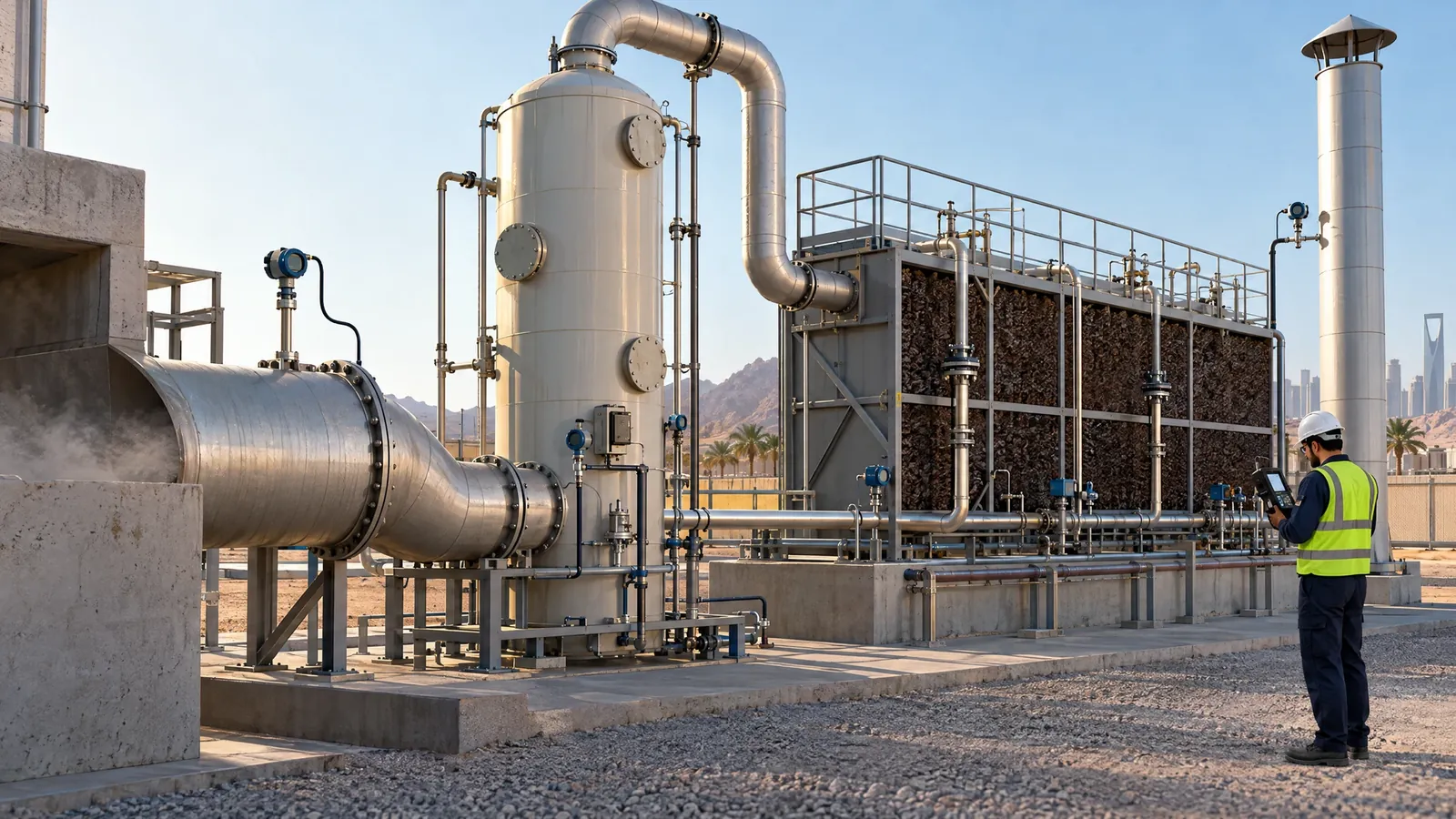
Odour control performance monitoring equipment we supply in Saudi Arabia
The Scentroid SL50 is one modular fixed platform we supply. Scentroid describes configurations with multiple gas-sensing technologies, communications, local storage, alarms and SIMS3 connectivity (Scentroid SL50). A project configuration should reflect the target gas, expected range, humidity, dust, temperature, interferences and required response time.
For sewer or covered-asset applications, the Scentroid THP10 combines H2S and differential-pressure monitoring according to its manufacturer, with optional gas sensors and SIMS3 communications (Scentroid THP10). Pressure and gas trends can support investigation of cover or extraction conditions; they do not alone diagnose every cause or replace a ventilation assessment.
SIMS3 is described as supporting historical data, alarms, event logs, device diagnostics, mapping and reports (Scentroid SIMS3). These functions can assemble a chronology showing monitor status, measured events and selected operating information. The data architecture should define timestamps, units, quality flags, access roles, retention and how missing or invalid values are handled.
From alert to approved action
An initial project can use notifications rather than automatic commands. For example, a persistent H2S rise or pressure change may prompt an operator inspection. After the relationship is understood, the facility may choose to pass a validated signal or status to its supervisory or building-management system.
Our odour-system and BMS control integration service can document signal type, protocol, update rate, alarm persistence, fault state, manual override, fail-safe expectation and responsibility boundary. Approved controls professionals must design and test the final logic. Any command affecting chemical dosing, fans, dampers or process equipment requires the operator’s hazard review and management of change.
The system should distinguish a measured alarm from an instrument fault, communications loss, maintenance state or out-of-range value. It should also avoid cycling equipment in response to short noise spikes. Persistence rules, hysteresis and verification steps are project decisions, not universal settings.
Verify performance over time
A baseline period helps document normal operating variation before thresholds are chosen. Subsequent reporting may compare events by loading, control mode, maintenance interval, wind sector or upstream/downstream condition. Portable surveys or targeted samples can investigate discrepancies. Where sensory concentration or compound-specific efficiency is required, a suitable laboratory and defined sampling method are needed.
Acceptance testing should exercise normal, alarm, fault, maintenance and communications-loss states. The test record should show what the monitor displayed, what signal the receiving system saw, which notification was issued and how the operator acknowledged it. Re-testing after material configuration changes helps keep the handover understandable.
The US EPA Air Sensor Toolbox emphasises matching sensor performance to intended use (US EPA Air Sensor Toolbox). We apply that principle by separating operational indicators from reference or compliance measurements. Any contractual performance commitment or permit demonstration requires its own agreed method, parties and acceptance criteria.
Deliverables can include the measurement basis, equipment and I/O schedule, point locations, data schema, alarm matrix, inspection steps, controls-responsibility matrix, test plan and reporting template. For sector-specific context, see wastewater and sewer odour monitoring or landfill, compost and waste-facility monitoring.
Control-performance monitoring and the associated integration handover are available for projects across Saudi Arabia, including industrial and utility sites in Riyadh, Jeddah, Dammam and Jubail.
To discuss an existing or planned control system, provide the process diagram, control description, target gases, available instruments, operating modes, BMS or SCADA interface and required decision through our contact page. We can scope the monitoring and integration handover. Request a quotation for odour control performance monitoring in Saudi Arabia.
Frequently asked questions
How do I measure odour control performance at my facility?
Monitoring can provide defined performance evidence when sampling points, conditions and metrics are suitable. Formal certification or a contractual performance commitment requires a separately agreed method and acceptance criteria.
Who provides odour control performance monitoring in Saudi Arabia?
Saudi Odour Monitoring supplies modular gas monitors, H2S and pressure units, weather instruments, communications, software and portable or sampling equipment for follow-up.
What affects the cost of odour control performance monitoring?
Cost follows the number of monitoring points, the gas and pressure channels and ranges, the signal and communications requirements, the integration scope and the testing needed.
How long does it take to set up control performance monitoring?
Timing depends on the number of control stages, the equipment configuration, the integration interface and the acceptance testing required. Lead time is confirmed in the quotation.
Can an alarm automatically start a fan or dosing system?
Technically, a suitable output may be integrated, but the operator’s approved controls professionals must design and validate the logic, interlocks, fail-safe states and manual override.
How are alarm thresholds selected?
Thresholds follow the objective, baseline data, sensor performance, process variation and required response. They should distinguish persistent events from noise, fault and maintenance states.
Is performance monitoring the same as odour treatment?
Saudi Odour Monitoring serves projects across Saudi Arabia, including Dammam, Al Khobar, Jubail, Riyadh, Jeddah, NEOM and Qiddiya.
No. Monitoring detects and contextualises conditions. Covers, extraction, scrubbers, carbon, biofilters, dosing or other engineered measures perform the treatment.