
Wastewater and Sewer Odour Monitoring in Saudi Arabia
Saudi Odour Monitoring supplies wastewater and sewer odour monitoring in Saudi Arabia for utilities, municipalities, developers and industrial operators. Wastewater and sewer odour can shift with flow, retention, temperature, pressure, aeration, covers, extraction and treatment performance, so we help build an evidence-led monitoring programme around these changing conditions. The scope can cover treatment plants, pumping stations, wet wells, manholes, inlet works, sludge areas and related boundaries. You receive a written proposal setting out the configuration, scope, lead time and price. Request a quotation
The objective may be to find recurring H2S events, compare assets, assess whether a cover or extraction system is operating consistently, respond to neighbouring reports or identify where targeted sampling is needed. We define the decision first, then select locations, equipment, logging intervals and response steps.
Map generation, release and movement
A wastewater odour survey begins with the process and collection-system map. Potential generation and release points can include long-retention sections, turbulent discharge, wet wells, inlet channels, screens, primary treatment, sludge handling, uncovered tanks and ventilation outlets. Condition, accessibility and safe-entry constraints are recorded before fieldwork.
Outdoor weather affects movement from open or ventilated sources, while pressure relationships can influence release from covered assets. Operating context may include flow, pump cycles, dosing, aeration, extraction, cover status, cleaning and maintenance. These data help explain events and choose where continuous instruments provide value.
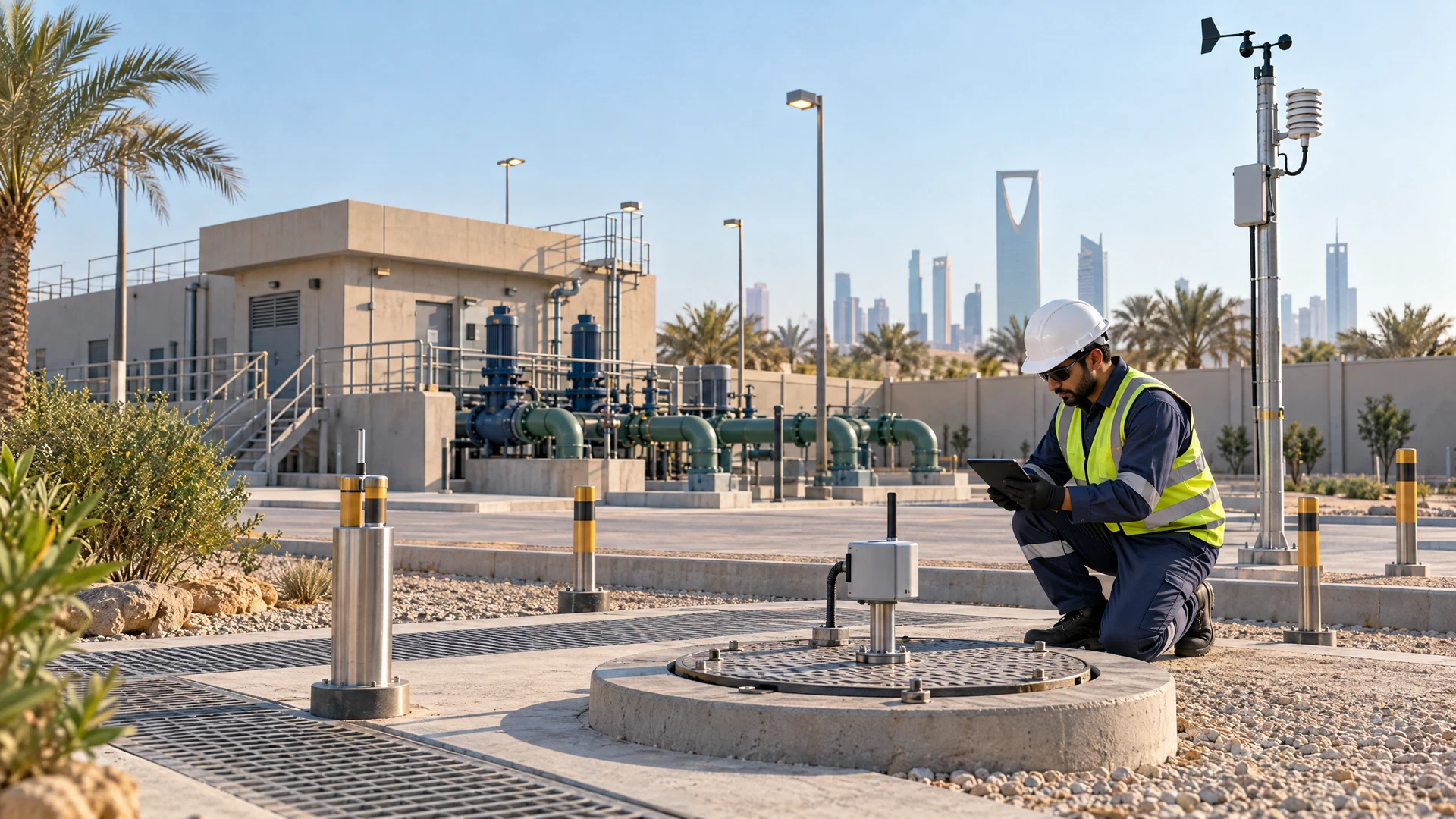
Wastewater and sewer odour monitoring equipment in Saudi Arabia
For remote sewer assets, the Scentroid THP10 is a product we supply. Scentroid presents the THP10 for combined H2S and differential-pressure monitoring and also lists optional gas-channel configurations including NH3, CO and VOCs, together with tamper alerts, GPS/modem functions and SIMS3 connectivity (Scentroid THP10). Confirm the exact ordered channels, ranges and product revision for the proposed unit; final configuration also depends on the asset, enclosure, communications and maintenance access.
At treatment plants or boundaries, a modular fixed platform such as the Scentroid SL50 may combine selected gas sensors with data communications. A portable Scentroid TR8 OdoTracker can support mapped screening around assets. Fixed trends show timing; portable checks help compare locations; neither automatically identifies all odorants in a mixture.
Sensor range is important. A unit chosen for low-level boundary trends may not suit high concentrations near a confined asset, while a high-range sensor may not resolve smaller off-site patterns. Humidity, condensation, temperature, cross-sensitivity and inlet fouling must also be considered. Instrument placement and servicing must follow safe work and hazardous-area requirements defined by the operator.
Keep odour investigation and safety separate
NIOSH states that hydrogen sulfide has a characteristic rotten-egg odour but rapidly causes olfactory fatigue, so smell cannot be relied on for continuous warning (NIOSH Pocket Guide — Hydrogen sulfide). This is an important safety principle, although the US exposure values on that page are not presented as Saudi limits.
Odour-monitoring equipment is not automatically a confined-space or personal-safety detector. Gas hazard assessment, entry permits, respiratory protection, evacuation thresholds and emergency response remain with the operator’s occupational-health and safety team. Our work can share site data with that team but does not replace its systems.
From event detection to corrective investigation
A practical plan defines normal baselines, event criteria, device checks, notifications and field response. If an H2S peak appears, staff may review pump cycles, pressure, dosing, ventilation or cover condition, then inspect the relevant asset from a safe location. For boundary events, wind and complaint timing add context.
Monitoring duration should include the conditions of concern: different flow periods, pump sequences, seasonal temperatures or maintenance states. Device health, inlet condition, battery or power state and communications gaps should be recorded with the measurements. This allows operators to distinguish a real reduction from an instrument outage and to compare events against a reliable operating chronology.
The resulting timeline also supports better maintenance discussions between operations, environmental and asset teams.
The wastewater and sewer odour application provides the sector overview, while hydrogen sulfide, ammonia and reduced-sulfur monitoring addresses compound-specific choices. If gas identity or odour concentration needs confirmation, our VOC and sulfur analysis coordination or dynamic olfactometry support can connect the project with a qualified laboratory.
Monitoring can also compare conditions before and after covers, extraction, scrubbers, carbon treatment or dosing. It does not purify air or take control of the process. Equipment supply does not replace the permit, approved method or regulatory decision that applies to your project. Any automated response, dosing change or interlock must be engineered and approved by the facility’s competent process, controls and safety professionals.
Deliverables can include the asset and source register, monitoring plan, equipment schedule, siting rationale, data-quality routine, alarm and inspection workflow, event summaries and recommended follow-up. To discuss a Saudi wastewater or sewer system, provide the asset map, flow pattern, known events, existing controls, access constraints and required decision through our contact page. Request a quotation for wastewater and sewer odour monitoring in Saudi Arabia.
Frequently asked questions
How do I choose which wastewater and sewer assets to monitor?
The scope can cover inlet works, tanks, sludge areas, vents, pumping stations, wet wells, manholes and boundaries, subject to safe access and the agreed monitoring question.
Who provides wastewater and sewer odour monitoring in Saudi Arabia?
Saudi Odour Monitoring supplies H2S and pressure monitors, modular fixed stations, portable instruments, communications, software and sampling equipment. Selection depends on range and site conditions.
What affects the cost of wastewater and sewer odour monitoring?
Cost follows the number of assets and locations, the gas and pressure channels and ranges, communications options, the monitoring period and any sampling or laboratory work.
How long does wastewater and sewer odour monitoring take?
Timing depends on the number of assets, the equipment configuration, safe site access and the operating conditions the monitoring period must cover. Lead time is confirmed in the quotation.
Can monitoring show why H2S rises at certain times?
It can support the investigation when concentration trends are compared with flow, pump cycles, pressure, temperature, dosing, extraction and maintenance. Further testing may still be needed.
Can odour monitors be used for confined-space entry?
Not unless the specific equipment is selected and managed for that safety purpose by safety professionals. This service does not replace confined-space gas detection or entry procedures.
Can the service check odour-control performance?
Saudi Odour Monitoring serves projects across Saudi Arabia, including Dammam, Al Khobar, Jubail, Riyadh, Jeddah, NEOM and Qiddiya.
Yes. Monitoring before and after a control stage can provide operational indicators when sampling points and comparable conditions are defined. It does not by itself certify treatment efficiency.