
Field Olfactometry and Odour Patrols in Saudi Arabia
Saudi Odour Monitoring plans field olfactometry and odour patrols in Saudi Arabia for industrial operators, utilities, municipalities, consultants and contractors. Field observations can reveal when, where and under what conditions an odour is encountered, and they are most useful when the route, timing, assessor instructions, weather records and reporting rules are defined in advance. Trained field personnel or specialist partners are used where the scope requires them. You receive a written proposal setting out the configuration, scope, lead time and price. Request a quotation
The service turns an informal “smell check” into a repeatable operational record. A patrol does not replace laboratory dynamic olfactometry or prove a source on its own, and it does not replace the permit, approved method or regulatory decision that applies to your project.
Define the patrol question
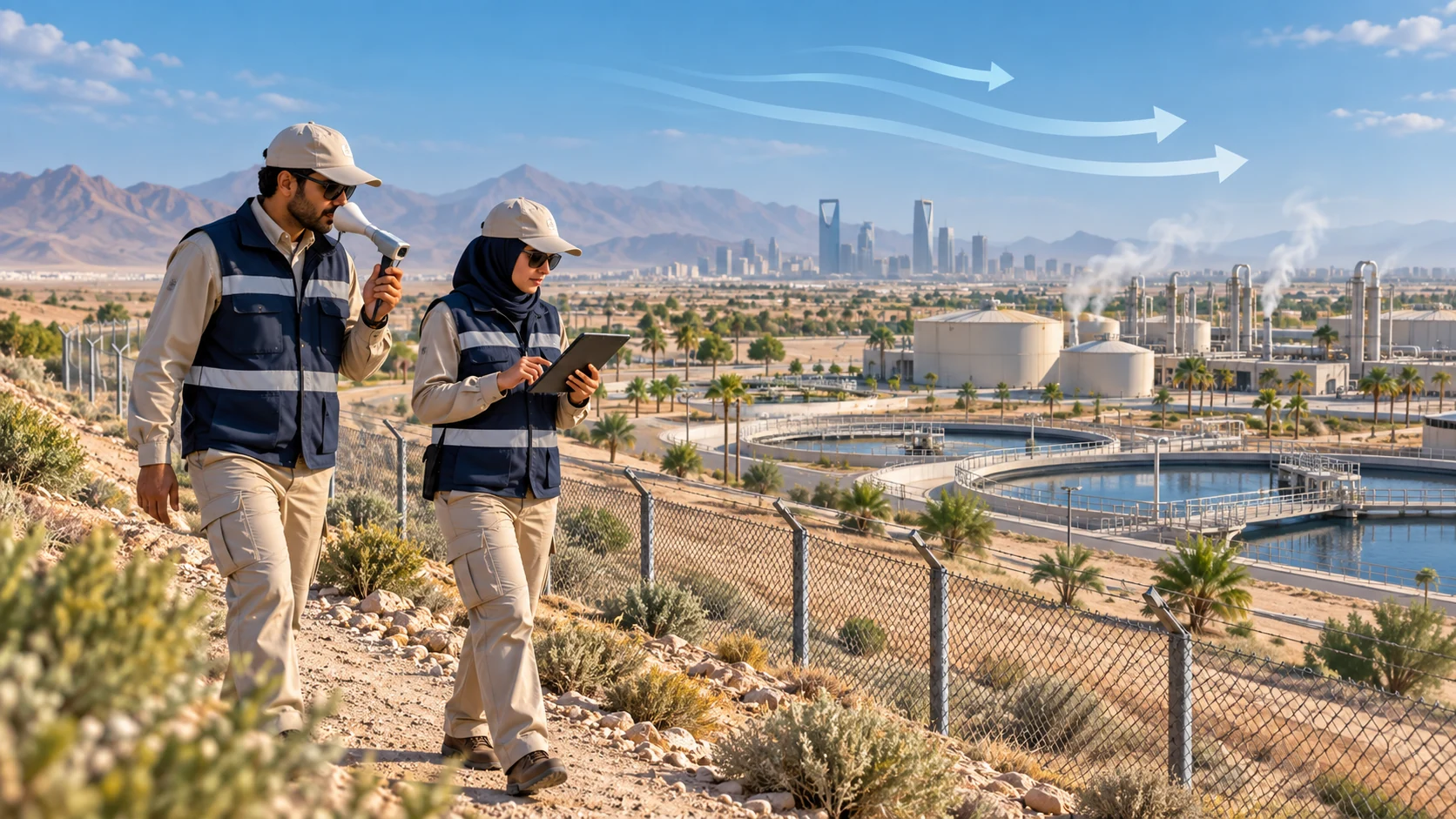
A patrol can investigate complaint times, compare upwind and downwind conditions, check a facility boundary, examine an intermittent activity or screen several candidate sources. We first define the event of interest, likely source windows, receptor areas and intended decision. A route designed for a wastewater plant will differ from one around a refinery, landfill, food operation or municipal neighbourhood.
The wider site odour screening and monitoring plan can combine patrol evidence with operating logs, continuous sensors and complaints. Where community reporting is central, our odour complaint investigation service helps standardise time, location, description and follow-up.
Field olfactometry and odour patrols: a repeatable route and schedule
We map observation points, safe stopping areas, access limitations and route order. Upwind or background points help establish context; downwind and receptor points are selected around plausible transport pathways. Patrol timing may target production cycles, sludge handling, loading, cleaning or other intermittent activity. Repeat visits across relevant wind sectors are often more informative than one visit made for convenience.
Each observation records time, coordinates, odour character, perceived intensity or persistence using the agreed scale, local activities, wind information and any instrument reading. An electronic platform such as Scentroid OdorMap can record geotagged complaints and observations with weather context. Manufacturer capabilities must be verified against the selected workflow; software does not validate an observation automatically.
Use field olfactometry within its limits
A handheld field olfactometer introduces filtered air at defined dilution steps to help a trained user estimate a field dilution-to-threshold response. Scentroid describes its SM100i as supporting direct ambient sampling or a sample bag. Final instrument setup, cleaning, filters, user training and field procedure must be agreed before deployment.
Human response varies, and fatigue, adaptation, expectation, illness, smoking, food and background odours can influence observations. The plan therefore addresses assessor readiness, rest, blanks, sequence, hygiene and exposure limits. Personnel should never be asked to smell an unknown atmosphere where health and safety have not been assessed. Gas detectors and site safety controls serve different purposes from sensory assessment.
Field olfactometry provides an operational field indication. Formal odour concentration through dynamic olfactometry requires controlled sample handling and a qualified laboratory/panel. Clients needing that result should use our dynamic olfactometry and odour-panel support.
Combine observations with objective context
Odour observations become more useful when time-aligned with wind direction and speed, temperature, humidity, process events and maintenance records. Portable gas sensors may add compound-class or selected-gas signals, but their range and cross-sensitivities must be reviewed. A chemical reading and a sensory response answer different questions.
For complex sites, meteorology, dispersion and source-attribution support can examine whether event timing is consistent with a source and pathway. Directional consistency strengthens a hypothesis; it is not automatically proof, especially where sources overlap or local airflow is complex.
Reporting and service boundaries
The patrol plan states the responsible field team, competence expectations, route, frequency, weather criteria, forms, equipment, quality checks, escalation and exclusions. A report may summarise event maps, recurring characters, wind sectors, process alignment, data gaps and recommended follow-up. Raw notes remain traceable so the client can distinguish observations from interpretation.
Our patrol programmes are available for projects across Saudi Arabia, including Riyadh, Jeddah, Dammam, Jubail and major project areas such as NEOM and Qiddiya. Any site access, hazardous-area, industrial-hygiene or formal regulatory requirements are confirmed for the individual project.
To request a patrol plan, use our contact page and share complaint or event timing, candidate sources, a receptor map, access and safety limits, and the decision the patrol should support. Request a quotation for field olfactometry and odour patrols in Saudi Arabia.
Frequently asked questions
Who should conduct an odour patrol?
Personnel should be trained in the agreed method, records, safety constraints and use of any field instrument. When a project requires independent or formally qualified observations, an appropriate specialist partner is included.
Who provides field olfactometry and odour patrols in Saudi Arabia?
Saudi Odour Monitoring plans the programme and supplies the equipment. The scope may include a verified handheld field olfactometer, location-enabled forms, weather instruments and selected gas sensors. Equipment depends on the field question and does not replace required safety monitoring.
Is field olfactometry the same as dynamic olfactometry?
No. Field olfactometry is an in-field observation under ambient or bag-sample conditions. Dynamic olfactometry is a controlled laboratory sensory analysis performed under the selected method by a qualified laboratory and panel.
How do I plan field olfactometry and odour patrol routes?
Routes consider candidate sources, safe access, background points, receptors, expected wind sectors and event timing. They are revised if early evidence shows that different locations or schedules are more informative.
Can patrol results identify a source?
They can support attribution when character, time, wind and operations align, but overlapping sources and subjective variability create uncertainty. We report the evidence level rather than guarantee a source.
What affects the cost of an odour patrol programme?
Cost follows the number of routes and observation points, the patrol frequency and duration, the equipment and software used, and whether a specialist partner is included.
How long does it take to set up an odour patrol programme?
Saudi Odour Monitoring serves projects across Saudi Arabia, including Dammam, Al Khobar, Jubail, Riyadh, Jeddah, NEOM and Qiddiya.
Timing depends on the event question, route design, site access and safety checks, and equipment configuration. Lead time is confirmed in the quotation.